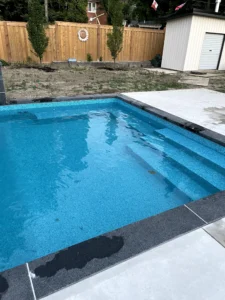
A pool by itself is a feature. A pool with a well-designed patio is an outdoor living space. The patio is where the summer actually happens: where people congregate after a swim, where outdoor meals take place, where kids dry off in the sun and adults settle in for the evening. Getting the patio right transforms how a pool is used and how the full backyard feels.
Toronto backyards present their own set of design considerations. Lots are often narrower than in newer suburban developments, Ontario winters demand materials that hold up through freezing temperatures and ground movement, and the relatively short but intensely used outdoor season makes every square foot count. The ideas that follow are grounded in what works in real Toronto and South Mississauga backyards: materials, layouts, and features that are as practical as they are appealing.
Start With How You Actually Use the Space
Before choosing materials or planning any specific feature, it helps to think clearly about how the pool patio will be used day-to-day. A family with young children needs a generous, open surface area for constant pool traffic, lots of barefoot-friendly surface, and clear sightlines from a seating area to the water. A household that primarily entertains adults has different priorities: space for outdoor dining, a bar area or outdoor kitchen nearby, lounge seating that encourages lingering rather than just pool access.
The size and shape of the existing pool matters too. A rectangular lap-style pool and a freeform naturalistic pool each suggest different patio configurations. A formal, symmetrical pool pairs naturally with a more structured patio layout; an organic pool shape invites a more relaxed, irregular patio design that follows the pool’s curves.
Getting this thinking done before the design process starts means the patio that results is genuinely suited to how the household lives, not just how the space photographs.
Layout Ideas That Work in Toronto Backyards
The Full Surround
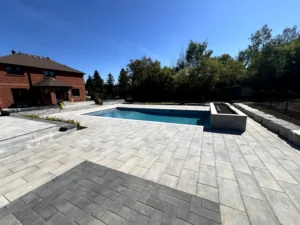
A continuous paved surface that wraps all the way around the pool is the most functional layout for a busy pool. It allows access from all sides, accommodates pool equipment access, and creates a complete visual frame for the water. For Toronto lots where the pool is centered in the yard with reasonable space on each side, a full surround typically works well and avoids dead zones of lawn that are awkward to maintain between the pool and the fence line.
The full surround works best when the patio surface connects naturally to the rest of the backyard: a seating area, an outdoor dining space, and ideally a transition toward the house that feels intentional rather than abrupt.
The L-Shaped or U-Shaped Deck
On narrower lots, or where the pool is positioned closer to one side of the yard, wrapping the patio around two or three sides rather than all four can be more practical than a full surround. This approach concentrates the patio space on the sides most used for entertainment and lounging, while leaving the back of the pool as grass or landscaping.
An L-shaped layout creates a natural division between an active zone (the open water-access side) and a relaxation zone (the longer arm of the L), which is a useful distinction when the same space needs to serve both swimming and outdoor dining.
The Split-Level Patio
A multi-level design, where part of the patio sits at pool level and a raised section creates a distinct upper lounge or dining zone, adds visual depth to the outdoor space and gives the backyard a more designed, purposeful feel. The level change also provides a natural sense of separation between areas without requiring physical barriers.
On sloped lots, which are not uncommon across parts of South Mississauga and Toronto, a multi-level design is often the most elegant solution to grade change, incorporating the natural topography into the design rather than working against it. Retaining walls that hold the upper level become a design feature rather than a purely functional element. Our retaining wall installation page covers how Destination Pools integrates structural and landscape walls into backyard designs across Toronto.
The Pool Deck Plus Floating Entertaining Platform
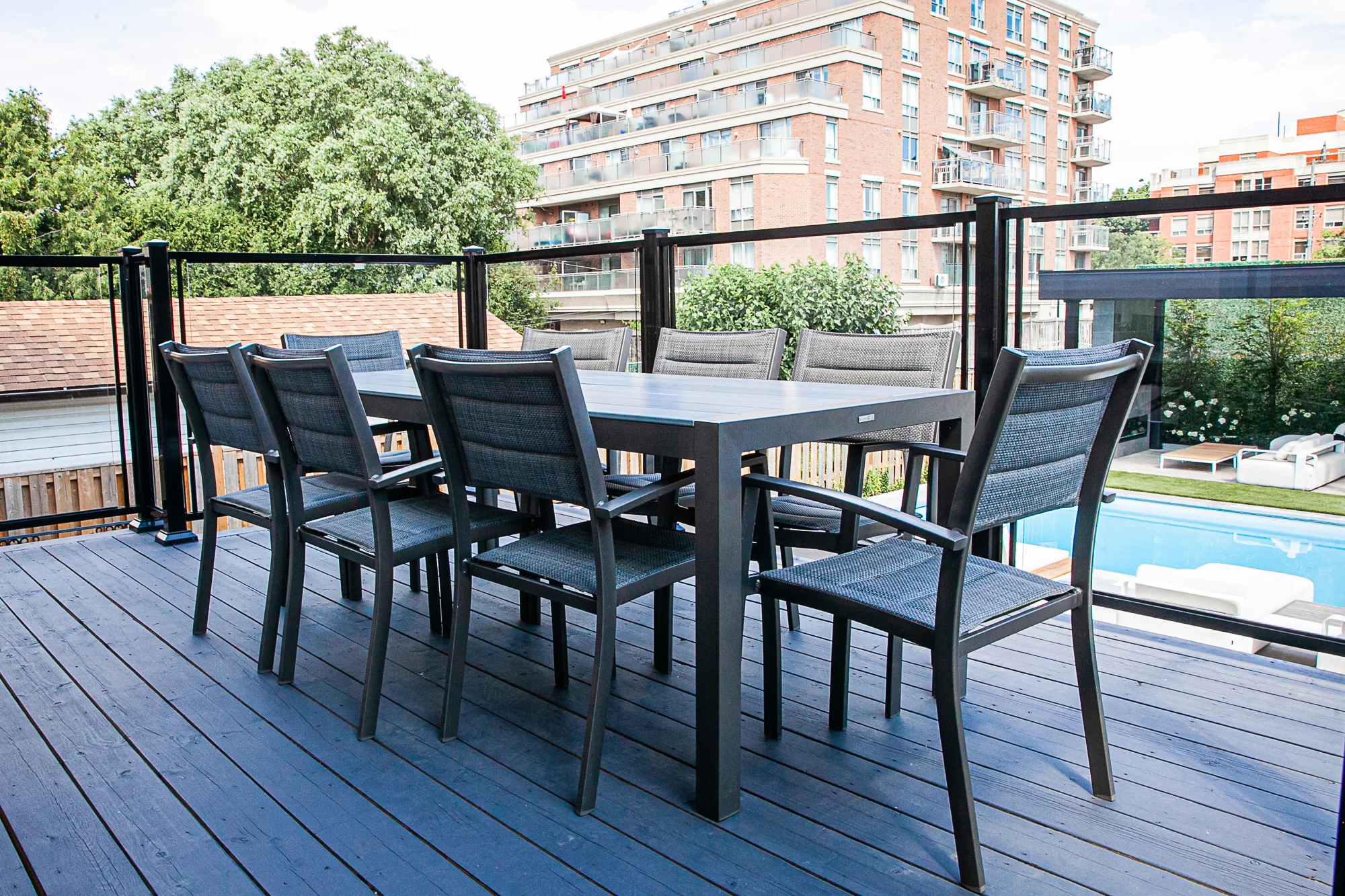
For yards where a full patio surround is not possible, or where a distinct entertaining zone feels more appropriate than a continuous paved surface, a smaller pool-level surround combined with a separate elevated deck platform is a practical solution. The deck platform, positioned for afternoon shade or with a sightline to the pool, becomes the dining and lounge hub. The pool surround handles the functional pool access. Plantings or a lawn section between them creates breathing room and softens what would otherwise feel like an entirely paved yard.
Material Choices for Toronto Pool Patios
The material you choose for the patio determines how it looks, how it performs through Ontario winters, and how much maintenance it requires over time. There are four materials most commonly used in Toronto pool patio projects.
Interlock Pavers
Interlock pavers are the most popular choice for pool patios across the Toronto area, and the reason is largely practical: they handle freeze-thaw cycling better than rigid poured surfaces. Individual units are set on a compacted granular base rather than mortared to a concrete slab, which allows them to shift slightly with ground movement without cracking. Any settled or raised pavers can be re-levelled with relatively minor repairs, unlike concrete where cracks and heaving require more involved remediation.
The design range in interlock has grown substantially. Large-format pavers in concrete, porcelain, or composite stone materials create a clean, contemporary look that reads almost like poured concrete but with the structural flexibility of a paver system. Tumbled or textured finishes suit more traditional or naturalistic designs. Pavers also extend naturally to walkways, driveways, and other outdoor surfaces, making a unified material language across the property straightforward to achieve. Our interlock driveway and walkway installation page covers the full range of what Destination Pools designs across an outdoor space.
Natural Flagstone
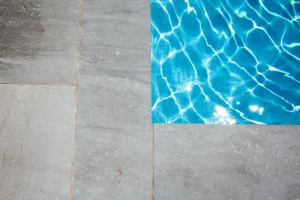
For homeowners pursuing a premium aesthetic, natural flagstone is unmatched in character. Limestone, travertine, granite, and slate each have distinct visual qualities. Limestone and travertine are warm and earthy, absorb less heat than dark materials, and have a surface texture that is naturally comfortable underfoot. Granite is harder and more resistant to staining, with a more refined and contemporary look. Slate brings rich tonal variation in greys and greens that suits naturalistic pool designs.
Flagstone pool patios typically become a defining feature of the backyard rather than just a surface. The investment is higher than pavers, both in material and installation, but the result adds genuine character and appeal to the property. For homeowners considering flagstone for both the pool patio and the driveway or front walkway, our flagstone driveway installation page shows the full range of applications.
Concrete
Poured concrete, particularly stamped or exposed aggregate concrete, remains a practical and flexible option for pool patios. It accommodates custom pool shapes well, since it can be poured to follow any contour. Stamped concrete can replicate the look of stone or pavers at a lower material cost. Exposed aggregate gives a textured surface with excellent grip, good UV resistance, and a natural-looking finish that pairs well with landscaping.
Concrete does require more maintenance attention in Ontario’s climate than paver-based alternatives. Sealing every two to three years, addressing surface cracks before they widen through water infiltration and freeze-thaw expansion, and eventual resurfacing as the surface finish weathers are all part of the long-term ownership picture for a concrete pool patio. Our post on concrete pool deck restoration in Toronto is a useful reference for understanding what that maintenance cycle looks like over time.
Composite Decking
For pool patios that incorporate a raised deck section, composite decking boards are a practical and low-maintenance choice. Modern composite decking is manufactured to resist fading, staining, and moisture damage far better than traditional pressure-treated wood. It does not require staining or sealing, holds its colour for many years, and does not splinter, which is an important consideration for bare feet around a pool.
Composite decking works particularly well in multi-level designs where a raised platform is combined with a hard surface pool surround. The material transition from paver or flagstone at pool level to composite decking on the raised platform creates a natural visual break that defines the different functional zones of the outdoor space. Our custom deck installation page covers the full range of elevated deck designs Destination Pools builds alongside pool projects.
Features Worth Including in a Toronto Pool Patio
Built-In Seating and Planters
Integrating seating walls or raised planters into the patio perimeter solves the clutter problem that loose patio furniture creates in a smaller backyard. A low stone or concrete block seating wall at the patio edge provides plenty of seating without furniture that needs to be moved, stored, or replaced. Built-in planters at the corners or along the fence line bring greenery into the space without pots that shift and tip over through the season.
Fire Features
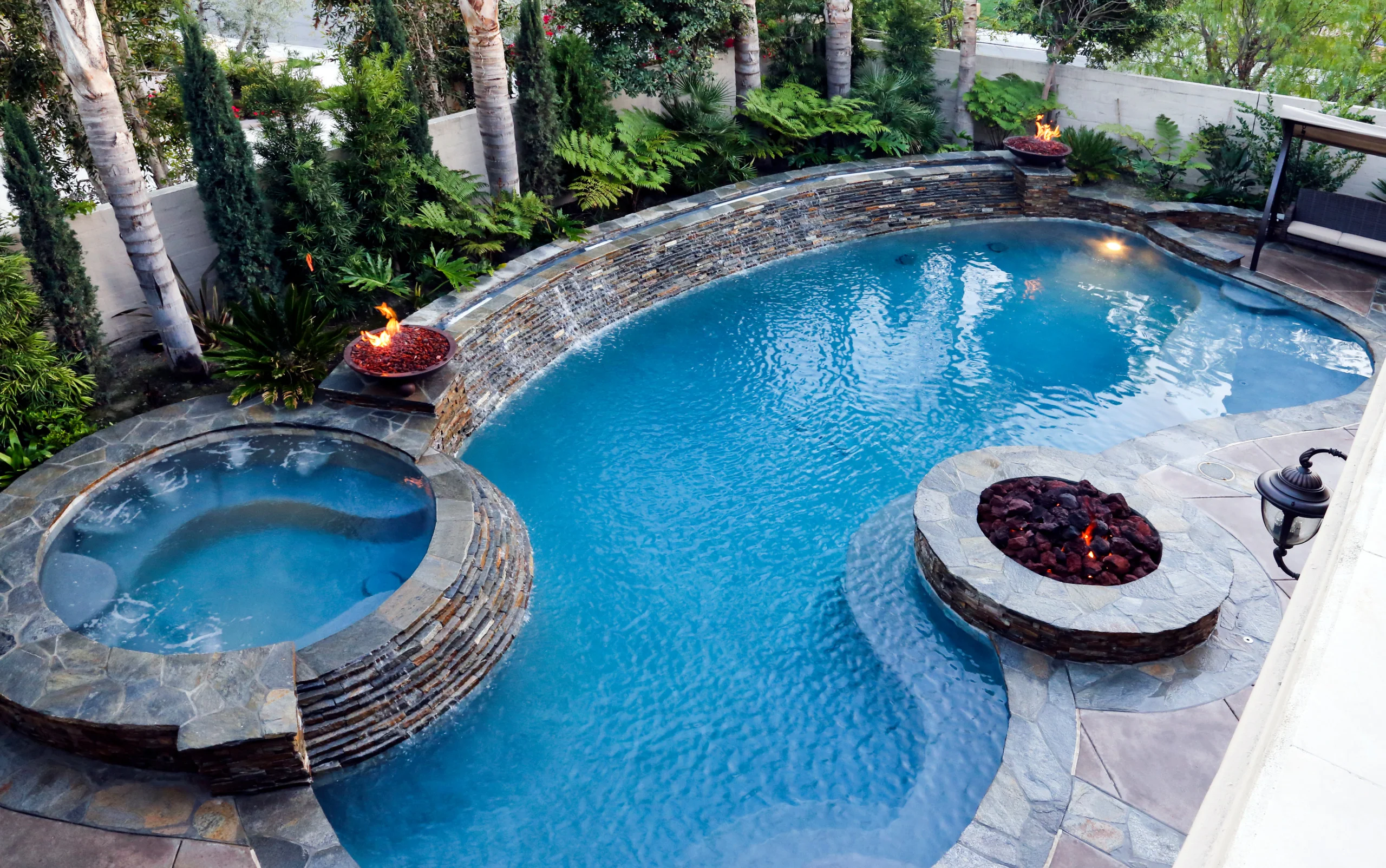
A gas fire pit or fire table extends the useable season of a Toronto pool patio by weeks in each direction. Cool May evenings and September nights that would otherwise drive people inside become comfortable outdoor time when there is warmth nearby. A fire feature positioned at the edge of the patio, away from the pool’s splash zone, gives the outdoor space a natural gathering anchor when the water is not in use.
Outdoor Kitchen or Bar Area
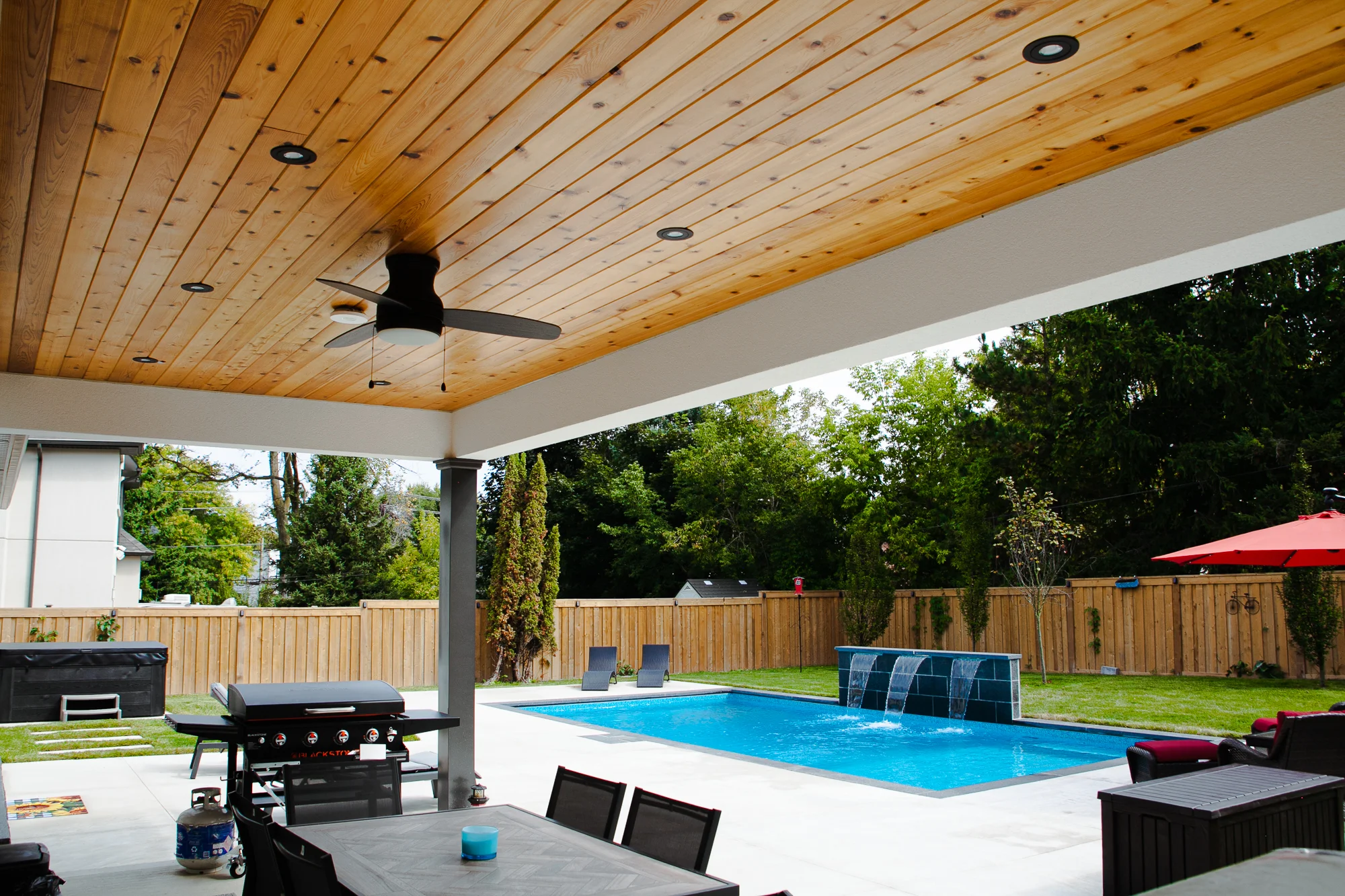
If entertaining is a priority, a dedicated outdoor kitchen or bar station is one of the features that most meaningfully changes how the pool patio functions. Even a modest setup, a built-in grill, a counter workspace, and a bar fridge, eliminates the constant trips between the house and the pool that break up the flow of outdoor gatherings. A full outdoor kitchen with a cooking station, sink, and covered structure makes the backyard a genuine extension of the home’s living and dining space.
Our outdoor kitchen installation page covers what Destination Pools designs and builds in Toronto and South Mississauga for homeowners who want a complete outdoor cooking and entertaining setup.
Shade Structures
A pergola, shade sail, or retractable awning over part of the patio creates the shaded seating zone that any outdoor living space benefits from in July and August. A shaded dining area or lounge corner makes it practical to be outside even during the hottest part of the day, particularly for household members who are not in the pool. Pergolas also create a natural structural anchor for outdoor lighting, hanging plants, and privacy screening.
Landscape Framing
The planting around a pool patio defines the character of the space as much as the hard surface itself. Evergreen hedging along fence lines creates year-round privacy and a green backdrop for the pool. Ornamental grasses planted in clusters around patio edges soften the transition between hard surface and lawn. Specimen trees positioned for afternoon shade on the patio provide functional benefit alongside visual interest. The landscaping around the pool is what makes the patio feel embedded in the yard rather than just placed on top of it. Our post on backyard landscaping ideas explores the planting and design approaches that work well across different backyard types.
Practical Considerations for Toronto Pool Patios
| Feature | Toronto-Specific Consideration |
|---|---|
| Material selection | Freeze-thaw performance matters; flexible systems outperform rigid concrete over time |
| Drainage | Toronto’s clay soil drains poorly; proper grading and drainage planning is essential |
| Privacy | Urban and suburban lot proximity means privacy screening (hedging, fencing, pergolas) adds significant value |
| Pool fencing | Ontario Building Code requires pool enclosure; design should integrate fencing as a feature rather than an afterthought |
| Sun orientation | South-facing patios maximize sun exposure during the season; shade structure placement should account for afternoon sun angles |
| Seasonal storage | Plan for furniture storage in a garage or shed; built-in seating reduces the furniture storage burden significantly |
Seeing What Is Possible
The best way to develop a clear vision for a pool patio project is to see completed examples across different backyard types and budgets. Our backyard pool ideas gallery shows a range of complete transformations from Toronto and South Mississauga projects, with different material combinations, layout approaches, and feature sets that reflect how different households use their outdoor spaces.
What stands out consistently across the best projects is that the patio was not designed in isolation. The pool, the deck surface, the surrounding landscape, and the outdoor kitchen or entertainment features were all planned as a connected whole, which is what makes the finished result look and feel like a cohesive outdoor living space rather than a collection of separate projects.
Frequently Asked Questions
How large should a pool patio be?
A common guideline is that the patio should be at least as large as the pool surface area itself, and ideally larger. A patio that is too small relative to the pool creates a cramped feeling and limits how many people can comfortably use the space. That said, lot size and budget are real constraints. On tighter lots, prioritizing the main functional areas (a generous stretch along the pool’s primary access side and a defined dining or lounge zone) over a full perimeter is a practical approach.
Do I need a permit for a pool patio in Toronto?
A ground-level patio that does not involve structural changes to the pool, plumbing, or electrical systems typically does not require a permit in Toronto. Raised deck structures above a certain height, attached structures, and changes near the pool’s mechanical equipment may trigger permit requirements. Our post on pool permits in Toronto covers which pool-related projects require permits and what that process involves.
What is the best patio surface for bare feet in summer heat?
Lighter-coloured materials absorb significantly less heat than dark ones, which makes a meaningful difference underfoot on a hot Toronto summer afternoon. Light limestone, travertine, and light-toned concrete all perform well in this regard. Light-coloured interlock pavers in concrete or composite stone are also comfortable. Dark-coloured concrete, dark slate, and very dark interlock units can become uncomfortably hot in direct sun during peak summer heat.
How do I keep my pool patio looking good through Ontario winters?
The biggest maintenance task for winter is removing leaves and organic debris before they break down and stain the surface. A quality patio cover or simply clearing the surface in fall reduces spring cleanup significantly. For paver surfaces, ensuring that polymeric joint sand is in good condition before freeze-up helps stabilize the surface through winter movement. For any sealed surface (concrete, flagstone), applying sealant before freeze-up rather than in spring gives the sealer a chance to cure properly and provides maximum protection through the cold months.
Can the pool patio be designed to grow in phases?
Yes, and phased design is a common approach for homeowners who want to spread the investment over multiple years. The most practical approach is to design the full patio layout in the first stage, including proper drainage and base preparation across the planned footprint, and then complete the surface material in phases. This avoids the cost and disruption of re-doing base work later. A good contractor will plan for future phases from the start rather than treating each phase as an independent project.
Plan Your Pool Patio With Destination Pools
Destination Pools designs and builds complete pool patio environments for homeowners across Toronto and South Mississauga. Whether you are starting with a new pool installation or transforming the space around an existing pool, we approach the project as a whole, coordinating the pool surround, elevated deck areas, outdoor kitchen, landscape, and lighting so that everything comes together as a connected outdoor living space.
Homeowners in Port Credit, Lakeview, Clarkson, and Mineola are welcome to reach out for a consultation. Contact Destination Pools to start the conversation about your backyard transformation.