A water feature is one of the few pool additions that changes the backyard whether or not anyone is swimming. Moving water gives the space a focal point, softens the flat blue rectangle that an unadorned pool can become, and produces a steady sound that does a surprising amount of work masking traffic and neighbouring noise, which matters in Toronto and South Mississauga backyards where lots are close together.
The category covers far more ground than the artificial rock waterfall most people picture. This guide walks through the main types, what each one demands structurally and mechanically, whether it can be retrofitted to a pool you already own, and the part almost every guide written south of the border leaves out: how it gets through an Ontario winter.
What a Water Feature Actually Adds
Before choosing a type, it helps to be clear on what you want from it, because the options serve genuinely different purposes.
Sound is the most underrated benefit. A feature with a meaningful drop and volume produces white noise that masks road and neighbour sound. A subtle spill produces almost none. If noise masking is the goal, that pushes you toward taller drops and wider sheets.
Visual focus is what most homeowners are after. A feature gives the pool a front and a back, an orientation, and something to look at from the patio or the kitchen window.
Circulation and aeration are secondary but real. Water pushed through a feature is aerated on the way, which helps a little with surface movement and can modestly cool the water on hot days. It is not a substitute for proper circulation, but it is not nothing.
Screening comes from feature walls specifically. A raised wall carrying a spill also blocks a sightline, which in a tight urban backyard can be as valuable as the water itself.
Sheer Descents and Cascades
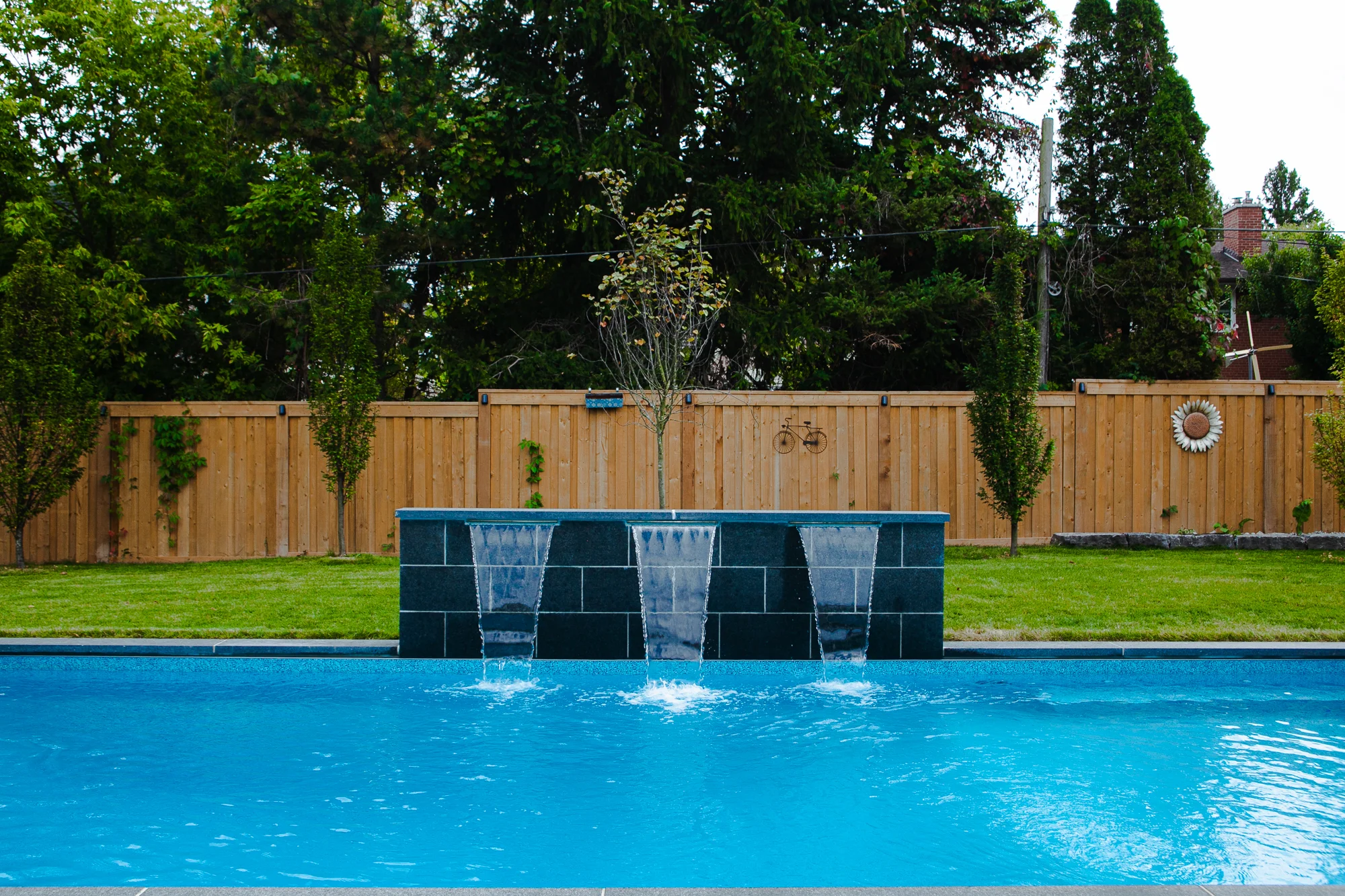
A sheer descent produces a smooth, clear, uninterrupted sheet of water falling from a slot into the pool. It is the defining look of contemporary pool design: architectural, quiet in a clean way, and dramatic when lit from behind.
Sheer descents are installed into a raised wall, a retaining wall, or a raised bond beam behind the pool, which means the structure to carry them has to exist or be built. They come in a range of widths, and multiple units set side by side, as in the three-sheet arrangement pictured above, give a wider presence than a single unit.
Cascades are the same idea with a rougher, more textured fall, producing more sound and a less formal appearance.
Scuppers and Spillways
Scuppers are spouts set into a raised wall that push water outward in an arc before it falls, rather than letting it sheet straight down. They read as more decorative and less architectural than a sheer descent, and they suit stone or brick feature walls particularly well.
Spillways are the broader category of water flowing over an edge, most commonly a raised spa or hot tub spilling into the main pool. A spa spillway is one of the most efficient water features available because the spa is already there, already plumbed, and already raised. If a raised spa is part of your plans, the spillway is close to free in design terms.
Deck Jets and Laminars
Deck jets are nozzles set into the pool deck that arc a stream of water into the pool. Laminars are the refined version, producing a solid, glass-like rod of water that holds its shape through the air and can be internally lit so the arc itself glows.
Both are worth noting for one reason: they require no wall, no raised structure, and no elevation change. On a flat backyard with a simple rectangular pool and no room for a feature wall, deck jets and laminars are often the only realistic way to add movement and drama. They do require plumbing runs beneath the deck, which is why they are far easier to include while a patio is being built than afterwards. If deck work is on your list, our guide to pool deck ideas in Toronto covers the surface decisions these features get built into.
Rock and Natural Stone Waterfalls
The naturalistic rock waterfall remains the most recognisable pool water feature, and for backyards with a landscaped, organic design intent it still fits better than anything else. Built from natural stone or from moulded artificial rock, it produces the most sound of any option and can be scaled from a modest single drop to a substantial multi-tier arrangement.
The considerations are weight and space. A natural stone waterfall is heavy, needs a properly engineered base, and occupies real footprint in the yard. Artificial rock is dramatically lighter and easier to place, at the cost of looking less convincing up close. Either way, the feature usually wants to be integrated with the surrounding grade and planting rather than dropped onto a flat lawn, which is where it starts to overlap with retaining wall and landscaping work.
Bubblers and Tanning Ledge Features
Bubblers sit in shallow water, typically on a tanning ledge or sun shelf, and push a low column of water upward. They are gentle, visually appealing, and unusually popular with young children, who treat them as a feature to sit in rather than look at.
Bubblers only make sense where there is shallow water to put them in, which ties them directly to whether your pool has a ledge or a wide entry. If you are already considering adding steps to an existing inground pool, bubblers are worth deciding on at the same time, because the plumbing has to be run while the pool is open.
Rain Curtains, Water Bowls and Fire Features
A rain curtain drops water through a perforated overhead channel, creating a wide, fine veil rather than a sheet. It is a striking effect and works best where there is a pergola or overhead structure to hang it from.
Water bowls are raised vessels set on pedestals or wall returns that fill and spill over their rim into the pool. Used in pairs flanking an entry or feature wall, they create symmetry without needing a large wall.
Fire and water combinations pair a bowl or feature wall with a gas fire element, which extends the backyard well into the cooler months in a way that water alone does not. That said, gas runs and clearances make them the most involved option here, and they need to be planned into the project early rather than added on.
Comparing Water Feature Types
| Feature Type | Structural Requirement | Plumbing and Pump Demand | Sound Level | Best Suited To |
|---|---|---|---|---|
| Sheer descent | Raised wall or bond beam required | Moderate to high, wider sheets need more flow | Moderate, smooth and consistent | Contemporary rectangular pools |
| Scuppers and spillways | Raised wall or raised spa required | Low to moderate | Low to moderate | Stone feature walls, pools with a raised spa |
| Deck jets and laminars | None, set into the deck surface | Low, though laminars need steady pressure | Low | Flat yards with no elevation change |
| Rock waterfall | Engineered base and significant footprint | High, volume drives the effect | Highest, best for masking noise | Naturalistic and heavily landscaped yards |
| Bubblers | Requires a tanning ledge or shallow shelf | Low | Low | Families with young children |
| Rain curtain | Overhead structure such as a pergola | Moderate | Moderate, soft and diffuse | Covered or partially covered pool areas |
| Water bowls | Pedestal or wall mounting point | Low | Low to moderate | Symmetrical and formal pool designs |
Retrofitting a Feature to an Existing Pool
This is the question that decides most of it. Adding a water feature to a pool that was not designed with one is possible, but how possible depends heavily on the type.
The most straightforward retrofits are features that draw and return through the existing system with minimal new structure. A spa spillway where a raised spa already exists, or a wall-mounted scupper on an existing retaining wall, are comparatively contained projects.
Features requiring new structure are a different matter. A sheer descent needs a wall built to carry it, which means footings, drainage, and a structure engineered to sit adjacent to the pool without loading it. A rock waterfall needs a prepared base. Both are realistically restoration-scale work rather than an add-on.
Two mechanical checks apply regardless of type. First, the pump and plumbing have to support the additional flow. A feature is another circuit drawing from the same system, and an older pump already working at its limit may not have the capacity, which is one reason feature additions and equipment upgrades often get planned together. Our post on upgrading pool equipment during restoration covers how pump sizing fits into that conversation. Second, features are best run on a dedicated valved circuit so they can be shut off independently, rather than being forced to run whenever the pool circulates.
The practical takeaway is that if a restoration or liner replacement is already on the horizon, that is the window where a water feature moves from difficult to straightforward.
Winterizing a Water Feature in the GTA
This is the section missing from nearly every water feature article, because most of them are written for climates that never freeze. In Toronto and South Mississauga, how a feature is winterized determines whether it survives its first decade.
The core principle is that every line, cavity, and nozzle serving the feature has to be fully cleared of water before the first hard freeze. Water left in a sheer descent slot, a scupper body, or a bubbler line will freeze, expand, and crack the housing, and those components are set into walls and decks where replacement means demolition rather than a swap.
In practice that means the feature lines are blown out and plugged as part of pool closing, the same as the skimmer and return lines. Features plumbed on a dedicated circuit are easier to isolate and clear properly, which is a good argument for that arrangement beyond just operational control. Raised feature walls should be built with drainage so water is not sitting behind stone through the winter, where freeze-thaw cycling will work joints apart over successive seasons. Freestanding elements such as water bowls are often best drained and covered, or removed entirely where the design allows.
None of this is difficult, but it does need to be built into the closing routine rather than remembered in November. Our pool opening and closing checklist for Ontario covers the broader seasonal process that feature winterizing slots into.
Designing the Feature Into the Whole Backyard
Water features work best when they are conceived as part of the landscape rather than added to the pool. A feature wall is a retaining wall with water running over it, so the grade, the planting behind it, and the patio in front all belong in the same drawing. A rock waterfall wants surrounding planting to look intentional rather than dropped in place. Lighting placed within or behind moving water is one of the highest-impact placements in a backyard, since water scatters light in a way that a still surface cannot, which our guide to LED pool light upgrades covers in more detail.
Thinking about it that way tends to produce a better result than treating the feature as a product to select, and it also means the wall, deck, planting, and lighting all get built in one coordinated project rather than in stages that have to work around each other.
Frequently Asked Questions
Can I add a waterfall to my existing pool?
In most cases yes, though the scope varies widely by type. Features mounted on an existing wall or spa are relatively contained. A waterfall or sheer descent that needs new structure built to carry it is closer to restoration-scale work and is best planned alongside other pool work.
How high should a pool waterfall be?
Height drives both sound and drama, so the answer depends on what you want. A taller drop produces more noise, which is useful for masking traffic but can be overwhelming close to a seating area. Feature walls in residential backyards commonly sit somewhere between knee height and above head height, and the right choice depends on sightlines, the size of the yard, and how close people will be sitting.
Are pool fountains and water features worth it?
For most homeowners the value is in how much more the backyard gets used, not in any technical benefit. A feature gives the space a focal point and a sound, which is what turns a pool into somewhere people sit even when nobody is swimming. The trade-offs are the added plumbing, the pump capacity required, and one more thing to winterize each fall.
Do water features need their own pump?
Not always. Many features run off the existing circulation system on a dedicated valved circuit. Larger features, or several running together, may need additional capacity, which is why pump sizing should be checked before a feature is designed rather than after it is installed.
Do water features increase pool maintenance?
Modestly. Features add surfaces where mineral deposits and staining can accumulate, particularly on stone, and they add lines that must be cleared at closing. Balanced water chemistry does most of the work in keeping deposits from building up on feature surfaces.
What is the easiest water feature for a flat backyard?
Deck jets and laminars, since they require no raised wall or elevation change and are set into the deck surface itself. They are considerably easier to install while a patio is being built than to retrofit into a finished deck.
Adding a Water Feature to Your Toronto or Mississauga Pool
The right water feature depends on what your backyard already gives you to work with: whether there is grade to build into, whether a wall or raised spa already exists, and whether the equipment has the capacity to run it. That is a design conversation more than a shopping decision.
Destination Pools and Landscaping designs and builds water features as part of complete backyard projects across Toronto and South Mississauga, including Port Credit, Lakeview, Clarkson, and Mineola, bringing the pool, feature walls, retaining walls, patio, and planting together as one outdoor living space. To talk through what would suit your pool and your yard, get in touch with our team.