For homeowners in Toronto and South Mississauga trying to plan a pool project, understanding what each term actually describes matters. It affects the scope of work you are agreeing to, the timeline you are planning for, and the realistic outcome you can expect. This guide defines each term clearly, explains when each applies, and helps you figure out which path makes the most sense for your pool.
Pool Resurfacing: Renewing the Interior Finish
Pool resurfacing refers specifically to the removal of a concrete pool’s interior finish and the application of a new one. It is the most targeted of the three scopes, addressing only the surface material inside the shell. The process involves draining the pool, preparing the shell, repairing surface-level cracks or damage, and applying the chosen finish, whether that is standard plaster (marbelite), quartz aggregate, or pebble aggregate.
Resurfacing addresses the following in isolation: a rough or deteriorating interior surface, persistent staining embedded in the old finish, and the desire to update the pool’s colour or texture. It does not address coping, tile, plumbing, equipment, lighting, or the deck and surround area. If those components are also in need of attention, the project scope expands into restoration or renovation territory.
Resurfacing applies specifically to concrete (gunite or shotcrete) pools. Vinyl liner pools have an equivalent process in liner replacement, and fiberglass pools use gel coat restoration or re-coating. The mechanics differ, but all three serve the same functional purpose: renewing the pool’s interior surface. Our post on pool resurfacing options in Toronto covers the three main concrete finish types in detail, including their lifespans, textures, and relative durability.
Resurfacing is the right scope when: the interior finish is worn, rough, or stained, and all other components of the pool (coping, equipment, plumbing, surrounding deck) are in good working condition.
Pool Restoration: A Comprehensive Renewal
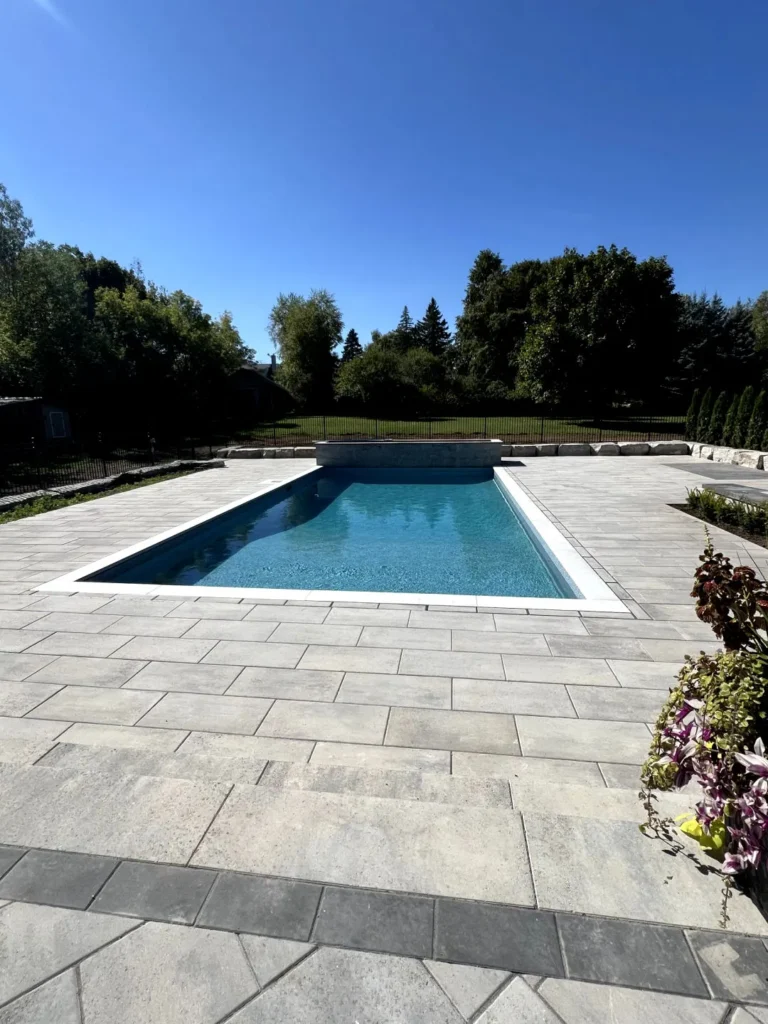
Pool restoration is a broader term. It describes the renewal of the pool’s major components, using the existing structure as the foundation. A restoration project typically involves some combination of the following: interior resurfacing or liner replacement, coping repair or replacement, waterline tile replacement or updates, equipment upgrades (pump, heater, filter, automation), leak repair, and lighting improvements.
The goal of restoration is to return the pool to full functionality and a refreshed appearance across multiple systems at once, rather than addressing one component in isolation. The pool’s structure, shape, and overall layout remain unchanged. Restoration does not involve adding new features that were not part of the original build, and it does not include structural modifications to the shell or surrounding area.
Restoration is often the more practical choice when a pool has aged to the point where multiple components need attention simultaneously. Addressing them all in one project window is more efficient than scheduling sequential repairs over several seasons. Many homeowners also take the opportunity to coordinate pool restoration with updates to the surrounding deck, landscaping, or outdoor living areas as part of a broader backyard refresh. Take a look at our backyard pool ideas gallery to see what a complete transformation can look like.
Restoration is the right scope when: the pool has multiple components showing wear, the goal is a comprehensive renewal of what is already there, and no significant structural or feature changes are needed.
Pool Renovation: Changing What the Pool Is
Pool renovation is the broadest of the three terms. It describes projects that alter what the pool is or what it can do, not just how it looks or how well it performs. A renovation might include expanding the pool footprint, changing the shape or depth configuration, adding a spa or hot tub that was not part of the original build, installing water features such as waterfalls, deck jets, or bubblers, reconfiguring entry steps or benches, adding or relocating lighting for a new effect, or converting to a new sanitation system.
A renovation will typically include restoration work as part of its scope, since the pool surfaces and components are being addressed as part of a larger project. But the defining characteristic of a renovation is that the pool comes out of the project functionally or structurally different from how it went in. The scale of disruption, timeline, and investment reflect that expanded scope accordingly.
Pool renovation is the natural conversation to have when a homeowner wants to build a fundamentally different backyard experience around the pool, one that incorporates the pool as one element of a larger outdoor living design. Projects that combine pool renovation with deck installation, outdoor kitchen construction, and landscaping fall into this category. If you are thinking at this scale, our pool installation page covers how we approach full custom pool and backyard builds in Toronto.
Renovation is the right scope when: the goal is to change the pool’s design, add features that were not part of the original build, or undertake a broader backyard transformation that redefines the space.
Side-by-Side Comparison
| Scope Element | Resurfacing | Restoration | Renovation |
|---|---|---|---|
| Interior surface (liner or finish) | Yes | Yes | Yes |
| Coping and waterline tile | No | Often | Yes |
| Equipment upgrade | No | Sometimes | Yes |
| Leak repair | Sometimes | Yes | Yes |
| Structural or shape changes | No | No | Yes |
| New features added (spa, waterfall, etc.) | No | Occasionally | Yes |
| Deck, landscaping, outdoor living | No | Sometimes | Yes |
| Pool shape or layout changes | No | No | Yes |
| Typical project timeline | 1 to 2 weeks | 2 to 4 weeks | 4 weeks or more |
| Disruption to the backyard | Low | Moderate | Significant |
Which Option Is Right for Your Pool?
The right scope depends on what your pool actually needs and what you want to achieve. Here are some practical starting points:
- If your concrete pool surface is rough or stained and everything else is in good shape, resurfacing is the targeted solution.
- If your vinyl liner is worn or tearing, liner replacement is the resurfacing equivalent for your pool type.
- If your pool has multiple aging components, such as a worn surface, deteriorating coping, and outdated equipment, restoration addresses all of them in one pass.
- If you want to add a spa, water feature, or change the pool layout, that is a renovation conversation.
- If you are planning a full backyard transformation around the pool, renovation with a broader outdoor living scope is the right framing.
The fastest way to determine what your pool needs is an on-site assessment. The warning signs that indicate restoration or renovation are also worth understanding before that conversation. Our post on signs your pool needs restoration walks through the most common indicators and what each one means for the scope of work ahead.
A Note on Permits in Toronto
Most resurfacing work and standard restoration projects, including liner replacement, resurfacing, coping replacement, and equipment upgrades, do not require a building permit in Toronto or Mississauga. Renovation work that involves structural changes, electrical additions, or mechanical alterations may trigger permit requirements depending on the scope.
Our detailed post on pool permits in Toronto covers what requires a permit, what does not, and how the process works for homeowners planning a pool project. If you are unsure whether your planned work falls under permit requirements, our team can advise you based on the specifics of the project.
Frequently Asked Questions
Which term should I use when contacting a contractor?
Use whatever description most accurately reflects what you think needs to be done, and let the contractor clarify the terminology from there. Describing your specific concerns, such as “the surface is rough and the coping is cracking” or “I want to add a spa and update the whole backyard,” is far more useful to a contractor than trying to use the right industry term. A good contractor will walk you through the appropriate scope based on your description.
Can restoration work be phased across multiple seasons?
Some components can be addressed in stages. For example, resurfacing can be done one season, with equipment upgrades following in a subsequent year. However, there are cases where phasing adds complexity, such as when coping needs to be removed for surface access anyway, making it more efficient to address both at the same time. Your contractor can help identify where phasing makes sense and where it would actually cost more in the long run.
Is there a meaningful quality difference between contractors for this type of work?
Yes, significantly. Surface preparation quality, product mixing precision, and curing process management all directly affect how long a resurfaced or restored pool holds up. Choosing a contractor with documented experience in pool restoration and a portfolio of completed projects in the Toronto and Mississauga area is worth the additional time in the selection process.
How do I get an accurate quote for pool restoration or renovation?
An accurate quote requires an in-person site visit. Photos and descriptions are useful starting points, but the condition of the shell, coping, plumbing, and equipment can only be properly assessed in person. Most reputable pool restoration contractors will provide a free on-site consultation and quote. Contact Destination Pools and Landscaping to schedule your free assessment in Toronto or South Mississauga.