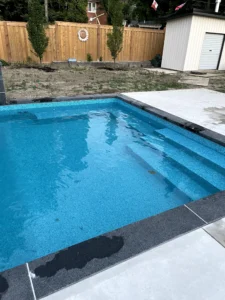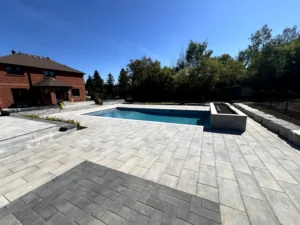
The skimmer is the least glamorous component of a swimming pool and one of the most consequential. It is the rectangular opening in the pool wall at water level where debris gets drawn in before it has a chance to sink, and it is the primary suction point feeding the entire circulation system. When it works, nobody thinks about it. When it fails, the symptoms show up everywhere else: air in the pump, poor circulation, water loss that never quite adds up, and a deck that starts to settle around the skimmer opening.
Skimmers also take a specific kind of punishment in the Toronto and South Mississauga climate. This guide covers how to tell when yours needs replacing, what the work actually involves, and why the plumbing lines behind it are worth addressing at the same time.
What the Skimmer Actually Does
Water is pulled into the skimmer through a hinged flap called a weir, which floats up and down with the water level and holds a thin layer of surface water moving toward the opening. Debris passes through into a removable basket, and the filtered water continues down the skimmer line to the pump.
Two things follow from that. First, the skimmer is doing the majority of the work in keeping surface debris out of the water, because leaves and pollen removed at the surface never sink to the floor to be vacuumed later. Second, because the skimmer is a suction point, any crack, gap, or failed seal in it does not leak water outward so much as draw air inward. That is why skimmer problems so often present as a pump that loses prime or a filter that keeps filling with air rather than as a visible leak.
Signs Your Skimmer Needs Replacing
A few symptoms come up repeatedly, and most of them are visible without any special equipment.
A crack in the skimmer throat or body. Look inside the skimmer with the basket removed. Hairline cracks running from the corners of the opening, or a crack across the base where the plumbing enters, are the most common failure point.
Separation from the deck. If there is a visible gap between the skimmer collar and the surrounding concrete or paver deck, or if the deck around the skimmer has settled relative to the rest of the surface, the skimmer has shifted. This usually means water has been getting into the surrounding fill.
A leaking faceplate on a vinyl pool. On liner pools the skimmer is bolted to the wall through the liner with a gasket sandwiched between. When that gasket hardens and fails, water tracks behind the liner. It is a slow, quiet leak that often gets blamed on evaporation for a season or two before anyone investigates.
Persistent air in the pump basket. Air being drawn in on the suction side has to come from somewhere, and a compromised skimmer is one of the most common sources. If the pump keeps losing prime and the water level is fine, the skimmer is worth checking early.
Water loss you cannot explain. If the level drops to just below the skimmer opening and then stops, that is close to diagnostic. Our post on signs your pool has a plumbing leak covers the bucket test and how to narrow down where water is going.
Why Toronto Winters Are Hard on Skimmers
This is the part that differs meaningfully from advice written for warmer climates, and it is the reason skimmer replacement comes up more often here than the equipment’s nominal lifespan would suggest.
The skimmer sits at water level, which is exactly the elevation where freeze-thaw cycling is most punishing. Any water left in the skimmer body over winter expands as it freezes, and the skimmer throat is the thinnest, most constrained part of the assembly. Repeat that cycle over enough winters and a hairline crack becomes a split.
The ground around the skimmer moves as well. Frost heave lifts and settles the deck and the fill behind the pool wall, which puts stress on the rigid connection between a fixed skimmer body and the plumbing running out of it. This is why skimmer failures often appear in the spring rather than mid-season, and why proper winterizing, including a correctly placed skimmer plug or gizmo and a lowered water level, does more to extend skimmer life here than anything else. Our pool opening and closing checklist for Ontario covers the closing steps that matter most.
Vinyl Liner and Concrete Skimmer Replacement Are Different Jobs
How the skimmer is replaced depends almost entirely on how the pool is built, and the difference in scope is significant.
On a vinyl liner pool, the skimmer is a separate unit bolted through the pool wall, with the liner clamped between the skimmer body and a faceplate. Replacing it means dropping the water below the skimmer, unbolting the faceplate, removing the old unit, fitting the new one, and resealing against the liner. The liner is a limiting factor: an old, brittle liner may not survive being unbolted and rebolted, which is why this work is frequently combined with a pool liner replacement rather than done in isolation.
On a concrete pool, the skimmer is encased in the pool structure and the deck. Replacement means cutting and removing a section of deck, breaking out the concrete around the old skimmer body, removing it, setting and plumbing the new unit, then pouring back and refinishing the deck. It is a substantially larger job, and the deck patch is often the most visible part of the result, which is why deck restoration frequently gets folded into the same scope.
What the Replacement Involves
| Stage | What Happens |
|---|---|
| Assessment | Skimmer condition inspected, leak location confirmed, and the condition of the connected lines evaluated |
| Water level drop | Water lowered below the skimmer opening so the assembly can be accessed |
| Deck access | On concrete pools, a section of deck is cut and removed. On vinyl pools, access is usually through the pool side |
| Removal | Old skimmer body detached from the plumbing and removed without damaging the wall or liner |
| Set and plumb | New skimmer positioned, levelled to the intended water line, and connected to the suction line |
| Seal and backfill | Assembly sealed, surrounding void filled and compacted so the new unit is properly supported |
| Deck and finish | Deck poured back or pavers reset, and the surrounding surface blended to the existing finish |
Replacing the Lines While You Are In There
Once the skimmer is out and the deck is open, the suction line running from it is exposed. On any pool more than a couple of decades old, this is the moment to look hard at that pipe, because opening the same ground again later is the expensive part.
Older pools were commonly plumbed with flexible PVC pipe, sold under trade names including Tiger Flex. It was popular for good reasons: it bends around obstacles without fittings, which speeds installation and reduces the number of joints where leaks can start. The drawback has become apparent with age. Flexible pipe is more susceptible to degradation over time than rigid PVC, it can be compromised by ground movement and by root intrusion, and when it does fail the failure is often somewhere along a buried run rather than at an accessible joint.
Rigid PVC is the more common choice on new work and on line replacement. It resists degradation better over a long service life and is easier to locate and repair, at the cost of needing fittings at every direction change.
| Consideration | Flexible PVC (Tiger Flex and similar) | Rigid PVC |
|---|---|---|
| Routing | Bends around obstacles with no fittings | Requires elbows and fittings at each turn |
| Number of joints | Fewer, which reduces initial leak points | More joints, each a potential future leak point |
| Long-term durability | More vulnerable to degradation and root intrusion over decades | Generally holds up better over a long service life |
| Ground movement | Absorbs some movement, but can be crushed or kinked | Rigid, relies on proper bedding and compaction |
| Locating and repairing a fault | Harder, failures often occur along a buried run | Easier, failures tend to occur at identifiable joints |
Neither material is the wrong answer in every situation. What matters is knowing which one is in the ground at your pool and what condition it is in, so the decision is made deliberately while the trench is open rather than by default. Our guide to inground pool plumbing covers how the suction and return sides of the system fit together.
Parts Worth Upgrading at the Same Time
Several skimmer components are inexpensive relative to the access required to reach them, so replacing them during the same visit is straightforward.
The weir, the floating flap at the mouth of the skimmer, warps and sticks with age, and a weir that does not float freely dramatically reduces skimming effectiveness. The basket cracks and lets debris through to the pump. The diverter, on skimmers with two ports, controls the balance between skimmer and main drain suction and should be verified as functional. The equalizer line, which prevents the pump from losing prime if the water level drops below the skimmer, is worth confirming is intact and correctly configured. The lid and collar at deck level become brittle in the sun and are both a trip hazard and an easy cosmetic improvement.
Coordinating the Work So the Deck Opens Once
The single most useful piece of planning advice here is to sequence skimmer work with anything else that requires the pool to be down or the deck to be opened.
If the liner is nearing the end of its life, replacing the skimmer during the liner change avoids unbolting an aging liner twice. If the coping or deck around the skimmer is already cracked or settling, addressing the skimmer at the same time means one demolition and one pour rather than two. If equipment upgrades are on the horizon, our post on upgrading pool equipment during restoration covers how pumps, heaters, and filters fit into the same window.
The general principle for older pools is that the disruptive parts of pool work, draining, excavation, and deck removal, are what drive the effort. Grouping everything that depends on them into a single project is almost always the better path.
Frequently Asked Questions
How hard is it to replace a pool skimmer?
On a vinyl liner pool it is a moderate job involving dropping the water level, unbolting the faceplate, and resealing the new unit against the liner. On a concrete pool it is a significant job requiring deck removal, breaking out the old skimmer, plumbing the new one, and repouring the deck. The concrete version is not realistically a do-it-yourself project.
How often should a pool skimmer be replaced?
Skimmers are not on a maintenance schedule the way a filter cartridge is. They are replaced when they crack, leak, or separate from the deck. In the Toronto climate, freeze-thaw cycling tends to be the deciding factor, and proper winterizing has more influence on how long a skimmer lasts than its age alone.
Can you run a pool without a skimmer?
Not well and not for long. Without a functioning skimmer, surface debris sinks and has to be vacuumed off the floor, circulation suffers, and a cracked skimmer will keep drawing air into the suction side, which stresses the pump. A compromised skimmer should be treated as a repair to schedule, not a problem to live with.
How do I know what type of pool skimmer I have?
Remove the basket and look at the opening. Vinyl liner pools have a visible faceplate bolted around the mouth of the skimmer with the liner clamped behind it. Concrete pools have a skimmer opening finished flush into the pool wall with no faceplate. The number of ports in the base tells you whether it is a single or dual-port design.
Should I replace the plumbing lines when I replace the skimmer?
It is worth serious consideration on older pools, because the access required to replace the lines is the same access already created for the skimmer. If the existing pipe is aging flexible PVC, or if there is any history of unexplained water loss on the suction side, doing both at once avoids reopening the same ground later.
Does the pool need to be drained completely?
No. The water only needs to drop below the skimmer opening, not out of the pool entirely. Fully draining a pool carries its own risks and is only done when the liner or structure requires it.
Suspect a Skimmer Problem at Your Pool?
Skimmer issues rarely stay contained. Air in the suction side stresses the pump, water escaping behind the wall undermines the deck, and a small crack at the throat becomes a deck repair if it is left long enough. Catching it early keeps the scope small.
Destination Pools and Landscaping handles skimmer replacement, plumbing line upgrades, and full pool restoration for homeowners throughout Toronto and South Mississauga, including Port Credit, Lakeview, Clarkson, and Mineola. If your pool is showing any of the signs above, or you are planning a broader project that will transform the whole backyard, reach out to our team for an assessment.