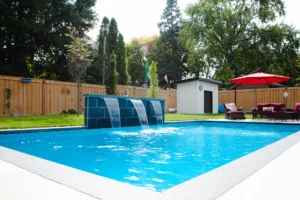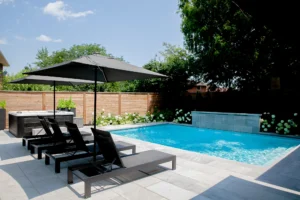
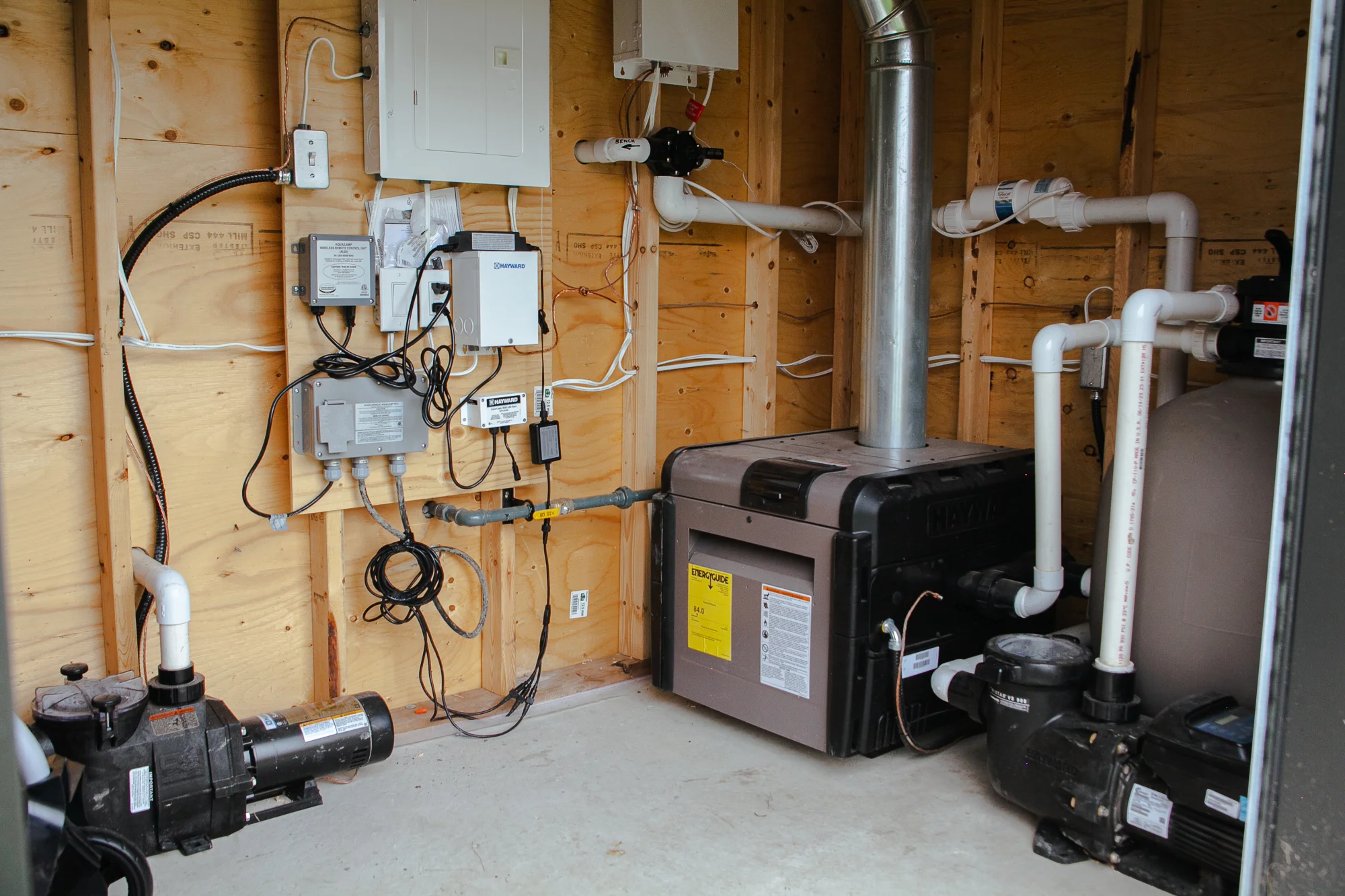
When homeowners plan a pool restoration, most of the attention naturally goes to what will be visible once the project is finished: the new liner pattern, the resurfaced interior, the refreshed coping. Equipment, tucked away in a shed or behind a fence, tends to get less consideration, even though it is doing the actual work of heating, circulating, and filtering the water every single day.
A restoration project is a particularly good moment to take a closer look at the pump, heater, and filter, simply because the pool is already drained and the work is already underway. This guide walks through why equipment upgrades are worth considering during restoration, what the main options look like, and how to think through the decision for your specific pool.
Why Restoration Is a Natural Moment to Reassess Equipment
Pool equipment has a finite service life, and much of it installed a decade or more ago is significantly less efficient than what is available today. A restoration project already involves draining the pool and, in many cases, disconnecting and reconnecting plumbing lines. That overlap means equipment access, and often equipment replacement, can happen with far less additional disruption than doing it as a standalone project later.
There is also a practical sequencing argument. Installing new equipment on an old, unrestored pool means potentially disturbing a newly resurfaced finish or freshly set coping again in a year or two, once the old pump or heater finally fails. Addressing equipment while the pool is already open for restoration work avoids that redundant disruption.
Pumps: The Heart of the Circulation System
The pool pump runs more than almost any other piece of equipment on the property, circulating water through the filter and heater for hours every day during the swim season. Older single-speed pumps run at one fixed speed regardless of what the pool actually needs at a given moment, which tends to mean higher energy use than necessary for routine circulation.
Variable-speed pumps, by contrast, can run at lower speeds for standard filtration and only ramp up when higher flow is genuinely needed, such as when running a heater or a water feature. For homeowners restoring a pool with an aging single-speed pump, this is one of the more commonly considered upgrades, both for efficiency and for quieter operation.
Heaters: Matching the Heater to How the Pool Is Used
Heater technology has evolved considerably, and the right choice depends heavily on how a pool is actually used. Gas heaters remain a strong choice for homeowners who want fast heat-up times and use the pool intermittently through the season. Heat pumps, which extract heat from the surrounding air rather than burning fuel, tend to suit homeowners looking to maintain a consistent temperature over a longer swim season, though their heating speed and cold-weather performance differ from gas units.
A restoration project is a good opportunity to revisit this choice, particularly if the existing heater was undersized for the pool, has become unreliable, or no longer matches how the household uses the pool compared to when it was first installed.
Filters: The Quiet Determinant of Water Clarity
Filtration is easy to take for granted until it is not working properly, at which point cloudy water becomes an ongoing frustration. The three common filter types, sand, cartridge, and diatomaceous earth (DE), each have different maintenance requirements and filtration fineness. Sand filters are low-maintenance but filter to a coarser degree. Cartridge filters offer finer filtration with a different maintenance routine. DE filters provide the finest filtration available but require more involved upkeep.
If an existing filter has been undersized for the pool’s volume, or if water clarity has been a persistent issue, a restoration project is a practical time to right-size or upgrade the filtration system alongside everything else being addressed.
Automation and Control Systems
Beyond the core equipment, many homeowners restoring a pool also consider adding or upgrading automation systems that allow equipment, lighting, and heating to be controlled remotely or scheduled automatically. Since restoration often involves reworking the equipment pad and its wiring regardless, this is a lower-friction time to add automation than retrofitting it onto an already-finished setup later.
Weighing the Equipment Upgrade Decision
| Equipment | Consider Upgrading If | May Not Need Upgrading If |
|---|---|---|
| Pump | Single-speed, older than 10 years, or notably loud | Already variable-speed and running efficiently |
| Heater | Undersized, unreliable, or use pattern has changed | Recently installed and matched to current usage |
| Filter | Persistent clarity issues or undersized for pool volume | Properly sized and maintaining clear water |
| Automation | Want remote control or scheduling; equipment pad is already being reworked | Manual operation suits household preferences |
Not every restoration needs an equipment overhaul. A pump or heater that is only a few years old and functioning well can often stay in place while other restoration work proceeds around it. The point is not to upgrade everything by default, but to use the restoration window as a genuine opportunity to evaluate each piece of equipment on its own merits.
Equipment Upgrades as Part of the Bigger Picture
Equipment decisions made during a restoration project connect to broader choices as well, including whether to convert the pool’s sanitization system. Our post on saltwater vs. chlorine pools in Toronto and our companion piece on converting to saltwater during restoration are worth reviewing alongside equipment decisions, since a sanitization system change can affect equipment compatibility.
Equipment upgrades are also part of the full backyard picture that Destination Pools considers with every restoration project. A refreshed pool, running on modern, efficient equipment, sets the stage well for other improvements to the surrounding space, whether that is a new deck, updated landscaping, or an outdoor kitchen addition down the line. Our pool restoration service page outlines the full scope of what a restoration project can include.
Frequently Asked Questions
Is it more cost-effective to upgrade equipment during restoration versus later?
Doing equipment work while the pool is already drained and accessible for other restoration work generally avoids the redundant labour of accessing the equipment pad and plumbing a second time. Beyond that overlap in access, the decision comes down to the condition and remaining service life of the existing equipment.
Will new equipment work with my existing pool plumbing?
In most cases, yes, though this depends on the specific equipment being installed and the age and configuration of the existing plumbing. A professional assessment during the planning stage of the restoration will identify whether any plumbing modifications are needed to accommodate new equipment.
How do I know if my pump or heater is actually due for replacement versus just needing service?
Persistent issues such as unusual noise, inconsistent performance, error codes on digital displays, or repeated repairs are signs worth having assessed. A pool professional can evaluate whether the equipment is serviceable or has reached the point where replacement makes more sense.
Can automation be added to a pool without full equipment replacement?
In many cases, automation systems can be added alongside existing equipment, provided the equipment is compatible. Restoration provides convenient access to the equipment pad and wiring, which can make installation more straightforward than a standalone retrofit.
Does upgrading equipment affect energy costs?
Newer equipment, particularly variable-speed pumps and properly sized heaters, is generally designed to run more efficiently than older single-speed or oversized equivalents. The actual impact depends on the specific equipment being replaced and how the pool is used.
Talk to Destination Pools About Equipment Options
If you are planning a pool restoration and want to understand your equipment options, Destination Pools works with homeowners across Toronto and South Mississauga, including Port Credit, Lakeview, Clarkson, and Mineola, to evaluate existing equipment and plan upgrades as part of a complete restoration project.
Contact Destination Pools to discuss your pool’s equipment and what makes sense for your restoration project.