Backyard sports courts have become an increasingly popular investment for Toronto homeowners, and the question we hear most often is a simple one: basketball or pickleball? Both offer a tremendous amount of value in terms of activity, entertainment, and long-term use of your outdoor space, but they have different space requirements, different audiences, and different installation considerations.
This guide breaks down what you need to know about each option so you can decide what fits your lot, your family, and your goals. And if you want both, a multi-sport court may be the answer. For more on what a custom sports court installation looks like on a Toronto property, visit our sports court installation page.
Court Size Comparison
The most immediate factor for most Toronto homeowners is available space. Lot sizes in the city vary significantly, and not every property can accommodate every court type.
| Court Type | Playing Area | Recommended Total Surface | Notes |
|---|---|---|---|
| Full Basketball Court | 50 ft x 94 ft (NBA standard) | 60 ft x 104 ft with buffer zones | Rarely practical for residential lots |
| Half Basketball Court | 25 ft x 45 ft to 30 ft x 50 ft | 35 ft x 55 ft recommended | Most common residential basketball setup |
| Pickleball Court (Singles or Doubles) | 20 ft x 44 ft | 30 ft x 60 ft recommended | Fits comfortably on many Toronto lots |
| Multi-Sport (Half Basketball + Pickleball) | Combined layout | 35 ft x 60 ft or larger | Pickleball lines overlap within the half-court |
The size difference between a pickleball court and a full basketball court is substantial. Three pickleball courts can fit within a single full-size NBA basketball court. For most residential Toronto backyards, a full basketball court is simply not feasible. A half-court is a more realistic basketball option, and a pickleball court is the most space-efficient of all.
Who Plays and How
Beyond the numbers, the right court choice often comes down to who in the household will use it and how they prefer to be active.
Basketball has a multigenerational appeal in Toronto. Kids can use a hoop from an early age, teens and adults can run half-court pickup games, and a backboard with an adjustable hoop works for players of almost any height and skill level. It is also a sport where a single player can practice independently without needing other people present.
Pickleball has grown rapidly in popularity and is now one of the fastest-growing sports in North America. It is accessible to players of all ages and fitness levels, and the smaller court and lower-impact nature of the game make it particularly appealing for families that include both younger kids and older adults. It is a social sport by design, best played in doubles, and it generates a lot of activity in a compact space.
Basketball Courts: What to Know for Toronto Properties
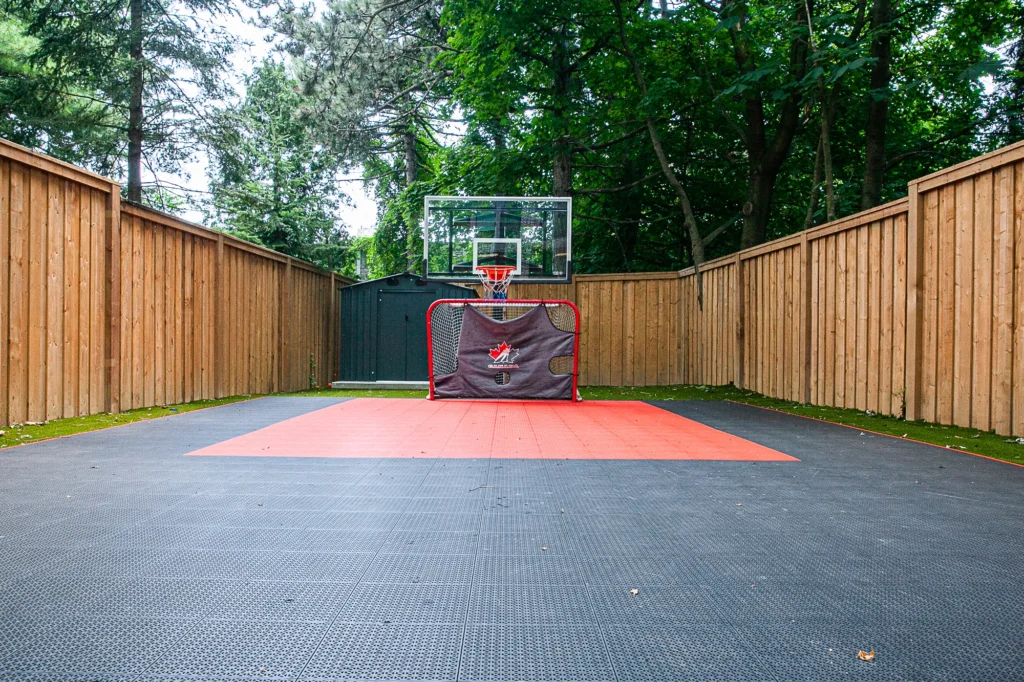
A half basketball court is the standard for residential installations in Toronto. It accommodates shooting drills, one-on-one play, and small pickup games without requiring the full footprint of a regulation court. The hoop is typically mounted on a pole set in concrete outside the court surface, or on a wall-mounted bracket if the court runs alongside the home or a fence.
Proper surface preparation matters considerably for basketball. The surface needs to be level, well-drained, and smooth enough for dribbling. Modular sport tiles are a common choice for residential basketball courts because they provide good bounce and traction and can be installed over an existing flat surface. Asphalt and concrete are also used as base surfaces.
One consideration for Toronto backyards is fencing. A court without perimeter fencing means lost balls every time a shot goes wide, which becomes frustrating quickly. Low netting or fencing around the perimeter is a practical investment alongside the court itself.
Pickleball Courts: What to Know for Toronto Properties
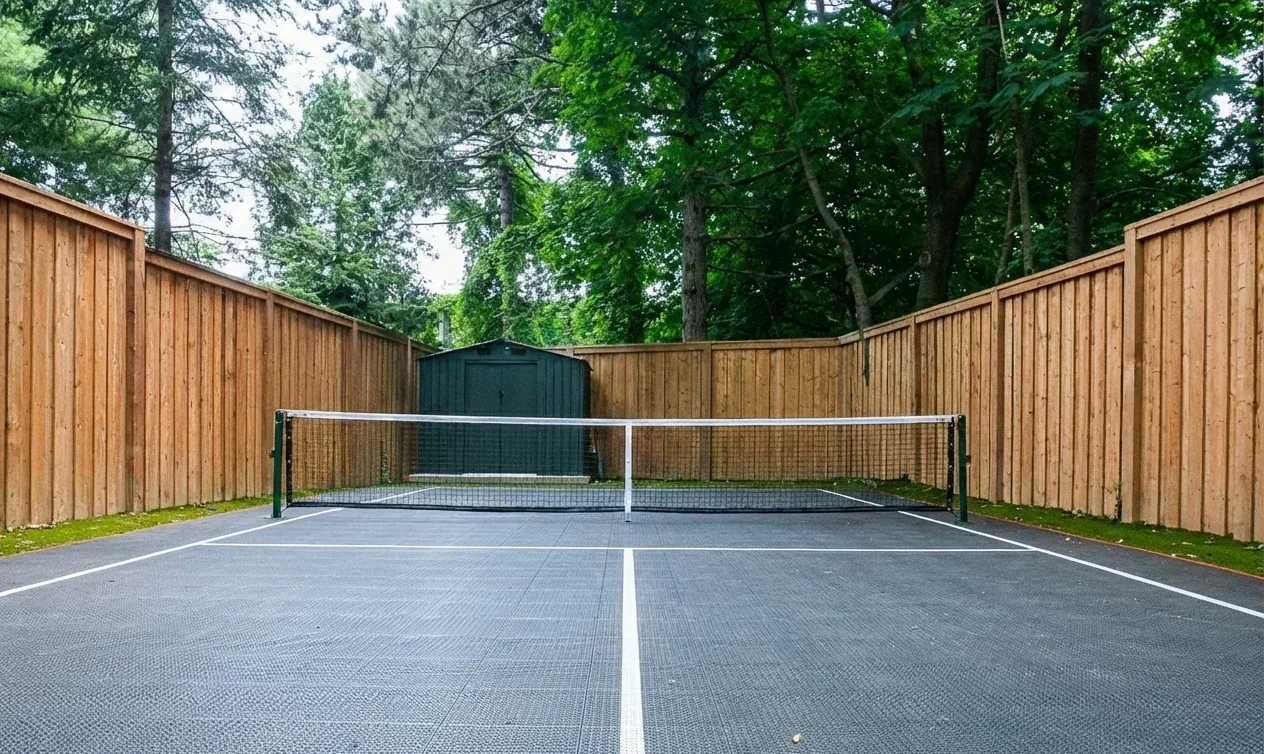
A pickleball court is a 20 x 44-foot rectangle, and the recommended total surface including out-of-bounds zones is approximately 30 x 60 feet. This footprint fits within many Toronto residential backyards, making pickleball one of the most practical court sports to install at home.
The court is divided by a net at the centre, with non-volley zones (known as the kitchen) marked 7 feet from the net on each side. Lines can be painted or applied with tape or inlaid in the surface material. For a permanent residential installation, painted lines on a proper sport surface are standard.
Pickleball is a doubles game at its best, meaning you typically need at least four players to get a full game going. That said, two-person practice and drilling works fine and does not require the full court space. The sport’s accessibility for all ages makes it a genuinely family-friendly investment.
Can You Combine Basketball and Pickleball on One Court?
Yes, and for many Toronto homeowners, a multi-sport court is the most practical solution. Pickleball lines fit neatly within a half basketball court footprint, meaning you can have both sports marked on a single surface using different line colours to distinguish the two. One surface serves both sports without compromise.
Full basketball plus two side-by-side pickleball courts is also possible on larger lots, but requires a significantly bigger footprint. A half-court with integrated pickleball lines is the most common and practical multi-sport configuration for residential Toronto properties.
Multi-sport surfaces designed for this kind of flexibility are available in modular tile systems that can accommodate basketball, pickleball, and even tennis or volleyball line markings, giving the court long-term versatility as interests change over the years.
Surface Material Options
The surface you choose affects performance, maintenance, and longevity. The three main options for residential sports courts in Toronto are:
Modular sport tiles: Interlocking plastic tiles that sit on top of an existing flat surface (concrete or asphalt). They provide good shock absorption, drainage through the tile gaps, and can be installed in multiple colours to delineate different court zones. They are also repairable, as individual tiles can be replaced if damaged. This is one of the most popular options for residential courts in Toronto.
Asphalt: A lower-cost base surface that is durable and handles Toronto’s freeze-thaw cycles reasonably well when properly installed. Standard asphalt is often used as the base under a modular tile system rather than as the finished playing surface, though it can be used directly with painted lines.
Concrete: Provides a very stable, flat surface with excellent longevity. It is harder underfoot than sport tiles or asphalt, which affects joint impact for players who use the court frequently. Concrete is the most permanent option and works well as a base for either sport tiles or direct-play finishes.
Integrating a Sports Court into Your Backyard
A sports court does not have to be an afterthought in your backyard layout. Thoughtful placement, perimeter fencing or netting, integrated lighting for evening play, and surrounding landscaping can make the court a feature of the yard rather than just a utility. Many of our Toronto clients integrate a court into a broader backyard design that includes a pool, a deck, and interlock paving connecting the different zones.
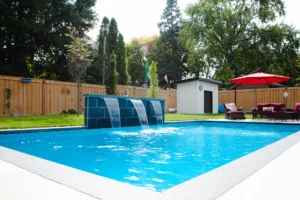
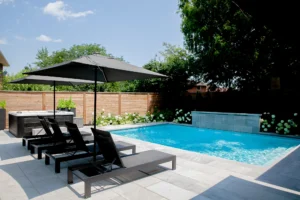
Explore our backyard landscaping ideas for inspiration, and visit our landscaping services page to see how we approach the full outdoor living picture. A sports court and a pool together create a backyard that stays active and engaged all season long.
Frequently Asked Questions
What size backyard do I need for a pickleball court in Toronto?
A standard pickleball court requires a playing area of 20 x 44 feet with a recommended total surface of at least 30 x 60 feet including out-of-bounds zones. Many Toronto residential lots can accommodate this footprint, making pickleball one of the more accessible backyard court sports.
Can pickleball and basketball share the same court?
Yes. Pickleball lines fit within a half basketball court footprint, and multi-sport surfaces can accommodate both games on a single surface using different line colours. This is a practical and popular choice for Toronto homeowners who want versatility without a larger footprint.
Do I need a permit for a sports court in Toronto?
An at-grade sports court surface typically does not require a building permit in Toronto. However, if a structure such as a fence, netting frame, or covered pavilion exceeds certain dimensions, a permit may be required. Your contractor should advise on the specifics for your property and scope of work.
What is the best surface material for a backyard sports court in Toronto?
Modular sport tiles over a concrete or asphalt base are widely considered the best option for residential courts in Toronto. They provide good traction and shock absorption, handle freeze-thaw cycles well, and allow individual tiles to be replaced if damaged. They are also available in multiple colours for multi-sport line layouts.
How long does a backyard sports court last?
A properly installed sports court with a concrete or asphalt base can last 20 to 30 years or more. Modular sport tiles on the surface can be replaced as needed without disturbing the base. Annual inspection and minor maintenance, such as cleaning and checking for shifted tiles, keeps the surface in good condition over the long term.
Build Your Toronto Backyard Sports Court
Whether you have decided on basketball, pickleball, or a multi-sport setup, Destination Pools and Landscaping can design and install a court that fits your property and integrates with the rest of your outdoor space. We work with Toronto homeowners across the city to build backyards that are as active as they are beautiful.
Contact us today to discuss your sports court project and get a custom quote for your backyard.