
A backyard sports court is one of the more distinctive features a Toronto property can have. For families with kids, active homeowners, or those who want a functional outdoor space that gets real daily use, it’s an investment that pays off through years of activity. It’s also a project where the scope and investment can vary considerably depending on what you’re building and what your yard requires.
Understanding the factors that determine the complexity of a sports court installation helps you plan the project effectively and evaluate proposals accurately.
1. Court Type and Size
The type of court you’re building determines the minimum size requirements, the surface needs, and how it functions. Different sports have different footprint requirements, and some installations combine multiple uses on a single surface.
| Court Type | Approximate Footprint | Common Uses |
|---|---|---|
| Basketball half-court | Approximately 15m x 14m (full court is roughly double) | Basketball; often doubles as a multi-sport surface |
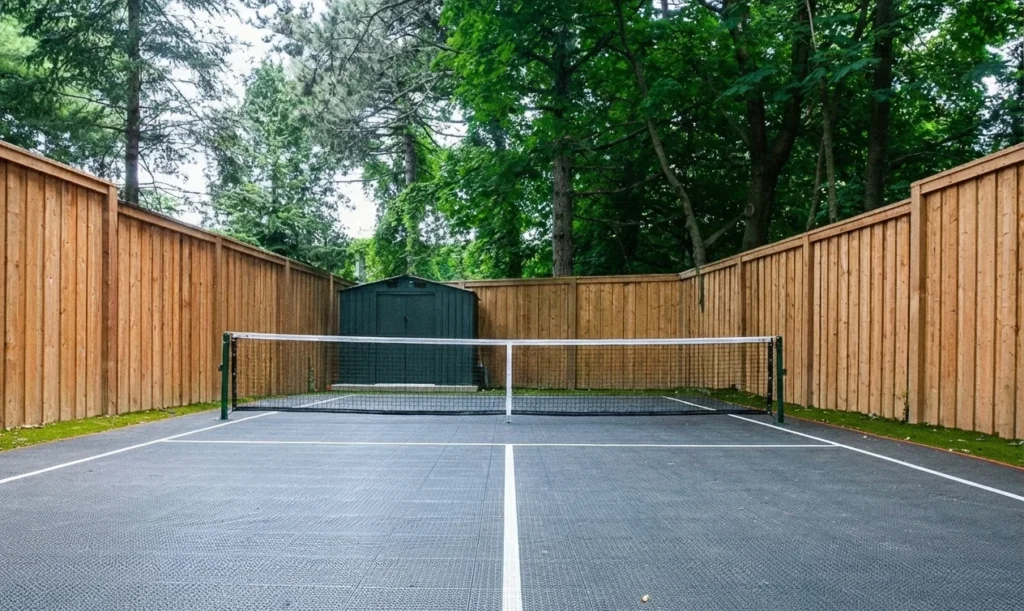
| Pickleball court | Approximately 9m x 19m | Pickleball; one of the fastest-growing court types in residential installations |
| Tennis court | Approximately 11m x 24m (singles); requires significant yard space | Tennis; largest footprint; typically for larger lots |
| Multi-sport court | Varies; designed around primary use case | Basketball, volleyball, badminton, pickleball; line markings for multiple games on one surface |
| Shooting pad or driveway rink | Compact; 6m x 10m or customized | Hockey shooting, skating; often installed on an existing hard surface or as a standalone pad |
2. Surface Type
The surface of a sports court needs to handle Toronto’s climate, including cold winters and freeze-thaw cycles, while also providing the right performance characteristics for the sport. Surface selection is one of the primary decisions in a sports court project.
| Surface Type | Performance | Durability in Toronto Climate | Maintenance |
|---|---|---|---|
| Modular sport tiles (e.g. SnapSports, VersaCourt) | Good traction and shock absorption; designed specifically for sport play | Very good; tiles flex with freeze-thaw movement without cracking | Low; individual tiles can be replaced if damaged |
| Asphalt with sport coating | Solid surface; coated for traction and line marking | Good; subject to cracking over time with freeze-thaw | Moderate; recoating and crack repair needed periodically |
| Concrete with sport coating | Very firm surface; good for multi-sport use | Good when properly mixed and reinforced | Low to moderate; sealing and recoating over time |
| Synthetic turf | Softer surface; good for multi-use and youth play | Good; infill may require redistribution seasonally | Moderate; brushing and infill maintenance |
3. Site Preparation and Grading
A sports court needs to be installed on a level, well-prepared base. For most properties, this means excavation, grading, and base compaction before any surface is applied. The extent of that work depends on the current condition of the yard.
Properties with significant slope require more grading work. The granular base below the surface needs to be thick enough to buffer Toronto’s clay soil movement and provide adequate drainage. Proper drainage design beneath and around the court prevents water from pooling on the surface and undermining the base over time.
4. Fencing and Netting
Most sports courts require some form of perimeter fencing or netting, both for ball containment and to define the playing area. The height, material, and configuration of the fencing affect both the appearance and the functional performance of the court.
Chain-link fencing is the most common approach for containment. Powder-coated steel fencing provides a cleaner look. Netting systems behind hoops or at court ends are used for specific sports. The height requirements vary by court type, with basketball and pickleball typically needing lower perimeter heights than tennis.
5. Lighting
Court lighting extends usability into evenings and makes the court practical through more of the year. LED sports lighting provides high-output illumination with low energy consumption. The number of poles and fixtures needed depends on court size and the level of illumination required.
Electrical work for court lighting requires a licensed electrician and must meet ESA requirements. Planning for lighting during the initial installation is more efficient than adding it later, as conduit can be run during base construction.
6. Integration With the Backyard
A sports court occupies a meaningful portion of a backyard, and how it’s integrated with the surrounding landscape determines whether it feels like a deliberate feature or an afterthought. Surrounding a court with appropriate fencing, planting, and pathways that connect it to the rest of the yard makes the court feel like part of the overall backyard design rather than a standalone pad.
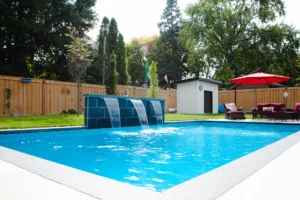
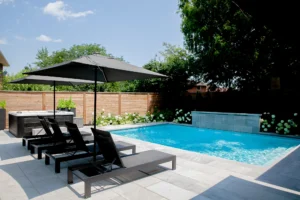
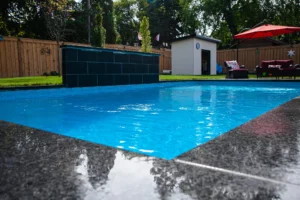
Sports courts are often installed alongside other backyard features: a pool, a deck, or comprehensive landscaping that ties the full yard together. Planning the court as part of a complete backyard project produces a more cohesive result and allows base work to be coordinated efficiently across the full scope. Our backyard ideas gallery shows completed projects where multiple features were integrated as a unified outdoor environment.
Frequently Asked Questions
Does a backyard sports court require a permit in Toronto?
It depends on the scope. A standalone hard surface installation typically does not require a building permit, but fencing above certain heights, electrical work for lighting, and structures associated with the court may trigger permit requirements. Your contractor should confirm what applies to your specific project before work begins.
What sports court surface works best in Toronto’s climate?
Modular sport tiles are particularly well-suited to Toronto’s freeze-thaw climate because the individual tiles flex with temperature changes rather than cracking. Asphalt and concrete surfaces also perform well when properly installed with the right base. Each surface has trade-offs in performance, maintenance, and lifespan that should be weighed against how the court will be used.
Can a sports court be built on a sloped yard?
Yes, but slope increases the scope of the site preparation work required. Significant grade changes require more excavation, additional base material, and potentially retaining walls on one or more sides to create a level playing surface. A site assessment will determine what is required for your specific property.
How long does a sports court installation take?
A straightforward sports court installation on a relatively level site typically takes one to two weeks. Projects that require significant grading, retaining structures, or lighting take longer. When the court is being built as part of a larger backyard project, the timeline is coordinated with the other elements.
What maintenance does a backyard sports court require?
Maintenance requirements depend on the surface type. Modular tile courts require minimal maintenance beyond occasional cleaning. Asphalt and concrete surfaces benefit from periodic recoating and crack repair. Synthetic turf requires brushing and infill redistribution. All surfaces benefit from clearing leaves and debris seasonally to prevent surface staining and drainage issues.
Thinking About a Sports Court for Your Toronto Backyard?
Destination Pools and Landscaping installs backyard sports courts for homeowners across Toronto and South Mississauga, as standalone features or as part of complete backyard transformations. If you’re planning a sports court and want to understand what makes sense for your yard, get in touch.