If you are planning a new driveway for your home in Toronto or Mississauga, one of the most common decisions you will face is choosing between an interlock driveway and a concrete driveway. Both options are popular across the GTA, both can look great when installed properly, and both can last for many years. The right choice usually depends on the style of the home, the budget, the long-term plans for the property, and how the driveway fits into the rest of the landscaping.
At Destination Pools, we install both interlock and concrete driveways as part of full outdoor projects, so we often help homeowners compare these two options side by side. In many cases, the driveway is not the only thing being built. It may connect to landscaping, walkways, retaining walls, or even a backyard renovation. When you look at the project as a whole, the best driveway material often becomes clearer.
If you want to see how each option is installed, you can also visit our interlock driveway installation page and concrete driveway installation page.
In this guide, we will go through the real differences between interlock and concrete driveways in Toronto, including cost, durability, maintenance, winter performance, appearance, and when each option tends to make the most sense.
What Is an Interlock Driveway?
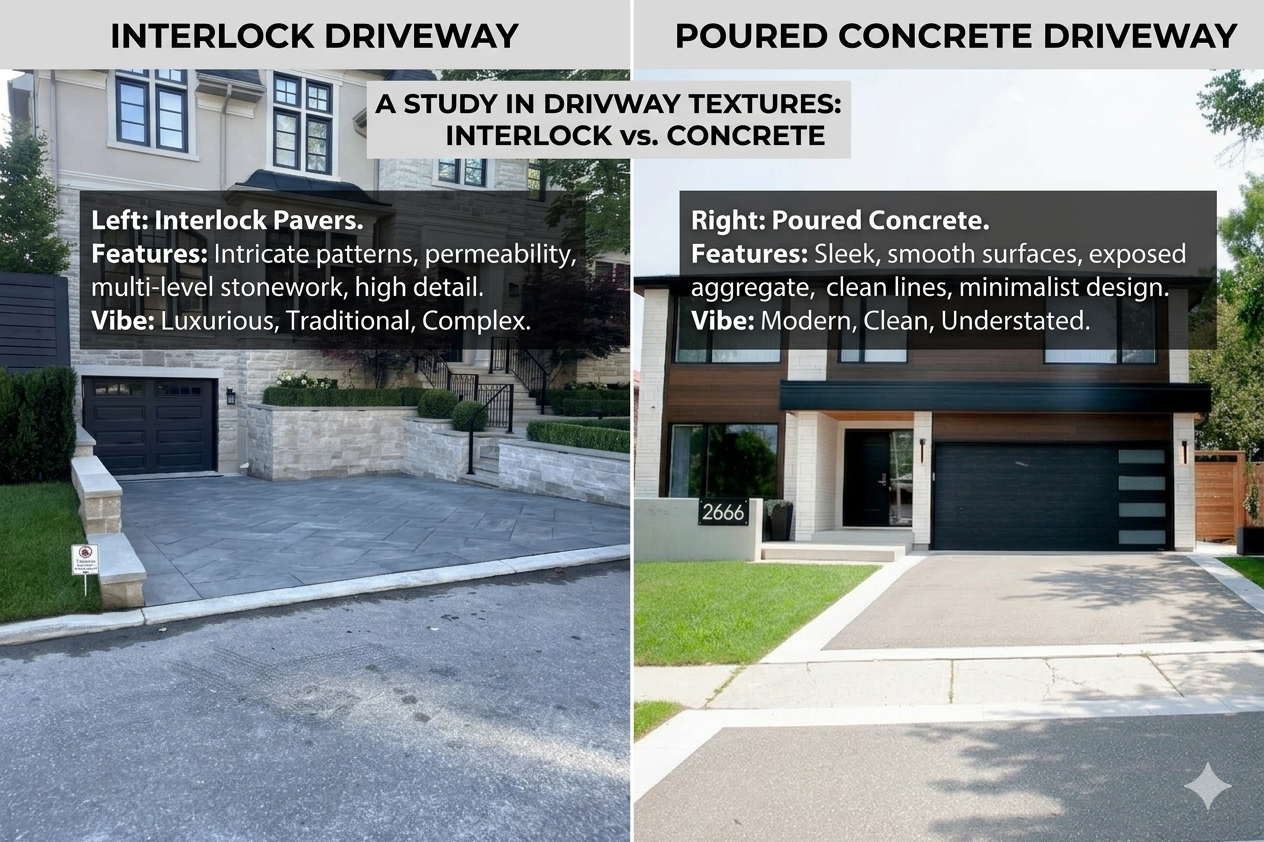
An interlock driveway is built using individual paving stones that are laid over a properly prepared base and locked together in a pattern. Because the surface is made up of many separate pieces instead of one solid slab, it has some flexibility built into the system. That flexibility is one of the reasons interlock is very common in Toronto, where weather conditions can cause the ground to shift over time.
Interlock pavers come in many different colors, sizes, and textures, which allows for a lot of customization. Some homeowners prefer a simple layout, while others want borders, patterns, or a design that matches the front entrance or landscaping. When the driveway is part of a larger exterior upgrade, interlock often blends well with other hardscape features such as steps, walkways, and garden walls.
Because of this, interlock is frequently installed together with broader landscaping projects or outdoor renovations where the goal is to make the whole property feel finished rather than just replacing the driveway alone.
What Is a Concrete Driveway?
A concrete driveway is typically installed as one continuous poured surface. Forms are set, the concrete is poured, finished, and then left to cure into a solid slab. Many homeowners like concrete because it provides a clean and simple appearance, and in many cases the installation process is faster than interlock.
Concrete does not always mean plain grey. There are several finishing options available, including brushed concrete, exposed aggregate, stamped concrete, and colored concrete. These finishes can change the look significantly, and for some homes a smooth, uniform surface fits the overall style better than a patterned driveway.
Concrete is often chosen when homeowners want something durable, straightforward, and cost-effective, especially for larger driveway areas. When installed correctly with a proper base, it can last a long time and perform well in Toronto conditions.
Cost Comparison in Toronto
Cost is usually one of the first things homeowners look at when comparing interlock and concrete. In general, a standard concrete driveway tends to have a lower upfront cost, while interlock usually requires a higher initial investment. This difference comes mostly from labour and installation time, since interlock involves laying individual pavers rather than pouring one surface.
That said, the total value of the driveway is not only about the installation price. Some homeowners are more focused on long-term flexibility, appearance, and how the driveway fits with the rest of the property. Others prefer a simpler solution that gets the job done at a lower cost. Both approaches are reasonable, and the right choice depends on the priorities for the home.
| Feature | Concrete | Interlock |
|---|---|---|
| Upfront cost | Usually lower | Usually higher |
| Design options | Moderate | High |
| Repair flexibility | Limited | Easier |
| Installation time | Faster | Slower |
| Custom look | Moderate | High |
In many higher-end neighborhoods in Toronto and Mississauga, homeowners sometimes choose interlock because of the design flexibility, but concrete is still a very common choice, especially when a clean, uniform look fits the style of the house.
Durability in Toronto Weather
Weather plays a big role in how driveways perform in the GTA. Freeze-thaw cycles, snow, salt, and moisture can all affect the surface over time, so it is important to understand how each material behaves in these conditions rather than assuming one is always better.
Interlock driveways are built from individual pavers, which allows the surface to move slightly without creating large cracks. If minor shifting happens, the affected area can often be adjusted without replacing the entire driveway. This flexibility can be helpful in climates where the ground expands and contracts through the seasons.
Concrete, on the other hand, is a rigid surface. When installed properly on a solid base, it is very strong, but it does not move the same way interlock does. If stress builds up from ground movement or moisture, cracks can appear. Some cracks are only cosmetic, while others may require repairs depending on the situation.
Neither material is automatically better in every case. The quality of the base preparation and installation usually has more impact on durability than the material itself. A well-built concrete driveway can last a long time, and a properly installed interlock driveway can also perform very well for many years in Toronto weather.
Maintenance and Repairs
Maintenance is another area where the two materials behave differently. Interlock may need occasional upkeep, such as refreshing joint sand, cleaning, or re-leveling small areas if settling occurs. However, one advantage is that repairs can often be done in sections without replacing the entire driveway.
Concrete generally requires less routine maintenance, but repairs can be more noticeable when they are needed. Cracks can sometimes be patched, but the repair may still be visible. If a larger section becomes damaged, replacing that area can be more involved than adjusting interlock pavers.
For some homeowners, the ability to repair small areas easily is important. For others, having a solid surface with minimal day-to-day maintenance is more appealing. The better option depends on how you plan to use the driveway and how long you expect to stay in the home.
Appearance and Design Options
Appearance is often the deciding factor for many homeowners. Interlock offers a wide range of colors, patterns, and border options, which makes it easier to create a custom look. This can be helpful when the driveway needs to match other features such as walkways, steps, patios, or backyard projects.
Concrete tends to provide a cleaner and more uniform appearance. Some homeowners prefer this because it looks simple and modern, especially on newer homes. Decorative finishes like stamped or exposed aggregate can add character, but the level of customization is usually less than what interlock allows.
When the driveway is part of a larger exterior upgrade, it may help to look at everything together. Projects that include retaining walls, custom decks, or outdoor kitchens often benefit from a driveway material that matches the rest of the design.
How the Driveway Fits Into the Whole Property
One of the biggest mistakes homeowners make is choosing a driveway without thinking about the rest of the property. The driveway is one of the first things people see, so it should work with the front entrance, the landscaping, and the backyard.
For example, if the property also includes a backyard renovation, pool, or outdoor entertaining space, the driveway material can be selected to match those features. Many homeowners planning larger upgrades like a pool installation or browsing the backyard ideas gallery end up choosing materials that create a consistent look across the entire property.
Thinking about the project as a whole often leads to better results than choosing each feature separately.
Which Driveway Should You Choose?
There is no single answer that works for every home. Interlock and concrete can both be good choices, and the better option depends on what matters most to you. Some homeowners prefer the design flexibility and repair options that interlock provides, while others prefer the simplicity and lower upfront cost of concrete.
The style of the house, the size of the driveway, the overall landscaping plan, and the long-term goals for the property all play a role in the decision. Looking at real examples and discussing the options with a contractor can make it easier to decide which material makes the most sense for your situation.
Book a Consultation
If you are planning a new driveway in Toronto or Mississauga, the best choice depends on your home, your budget, and how the driveway fits into the rest of your outdoor space. At Destination Pools, we help homeowners compare interlock and concrete options as part of a full exterior plan so the finished result feels complete.
Visit our contact page to schedule a consultation and talk about your project.
Is interlock more expensive than concrete in Toronto?
In most cases, interlock has a higher upfront cost because of the labour involved, but the total value depends on design, repairs, and long-term plans.
Does concrete crack in winter?
Concrete can develop cracks over time, especially if the base is not prepared properly or if moisture gets underneath the slab.
Is interlock better for cold weather?
Interlock can handle movement differently because it is made of individual pavers, but both materials can perform well when installed correctly.
Which driveway looks more high-end?
Interlock often allows for more customization, but concrete can also look very clean and modern depending on the finish.
Can I match my driveway with landscaping or a pool project?
Yes. Many homeowners choose driveway materials based on how they fit with landscaping, patios, or pool installations.