Three Real Options, Not One Right Answer
Once you know you want a rated safety cover rather than a standard winter tarp, the next decision is which type. Mesh, solid, and automatic covers all meet the same load-bearing safety standard, but they get there in different ways, and each comes with trade-offs that matter more or less depending on your pool and how you use your backyard.
This is a straight comparison, not a recommendation. If you are new to the category altogether, start with our pool safety covers 101 guide for the basics before comparing the three types below.

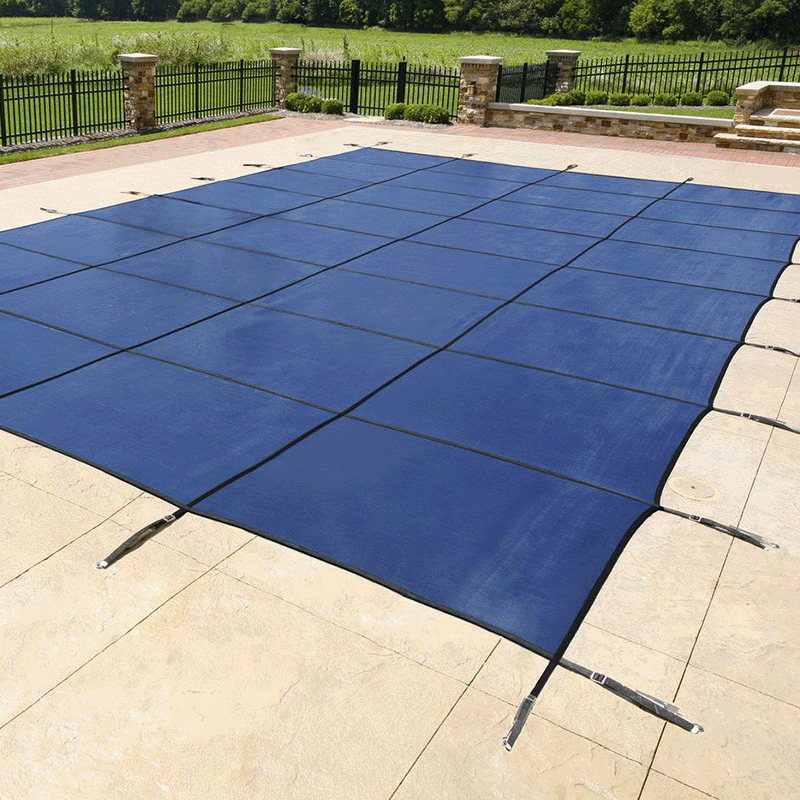
Mesh Safety Covers
A mesh safety cover is a woven fabric that allows rainwater and melting snow to drain through while keeping leaves, debris, and people or pets out. It anchors into the deck around the full perimeter using straps and springs.
Where mesh performs well
- Drains on its own, so there is no standing water to pump off before removal in spring
- Lighter than a solid cover, which makes it easier to handle during installation and removal
- Generally the lower-cost option within the safety cover category
Where mesh falls short
- Fine debris and some sunlight pass through the weave, which can allow more algae growth under the cover than a solid cover would
- Water clarity in spring is often not as good as under a solid cover, meaning more balancing work at opening
Solid Safety Covers
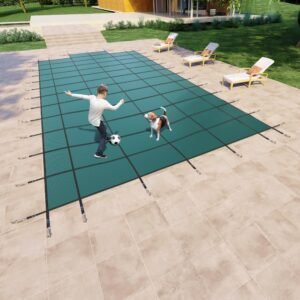
A solid safety cover is a non-porous fabric that blocks light and debris completely, with a separate mesh drain panel or built-in system to manage rainwater that collects on top.
Where solid performs well
- Blocks sunlight entirely, which does the most to prevent algae growth under the cover over winter
- Keeps the water noticeably cleaner and clearer through to spring opening
Where solid falls short
- Water collects on top and needs to be pumped off periodically, or managed through a drain panel that needs occasional attention
- Heavier than mesh, which makes handling it during installation and removal more physically demanding
Automatic Safety Covers
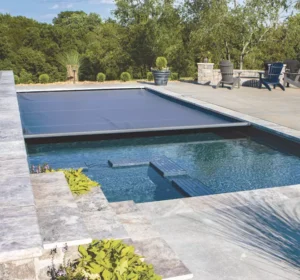
An automatic cover is a solid, load-bearing cover mounted on a track system built into the pool deck, opened and closed with the push of a button rather than installed and removed by hand each season. It is typically planned for during a pool build or a major renovation, since it requires the track system to be integrated into the deck.
Where automatic performs well
- Can be opened and closed daily, not just seasonally, which adds a safety layer and water protection benefit year-round, not only over winter
- No manual installation or removal each season once the system is in place
- Blocks light and debris as effectively as a solid cover, with the same water clarity benefit
Where automatic falls short
- The highest upfront investment of the three, since it requires a track system built into the deck
- Best suited to new pool construction or a full deck renovation, harder to retrofit onto an existing pool and deck without disruption
- Mechanical components mean more to maintain over the system’s lifespan than a manual cover
| Feature | Mesh | Solid | Automatic |
|---|---|---|---|
| Blocks sunlight fully | No | Yes | Yes |
| Drains on its own | Yes | Needs pumping or a drain panel | Needs pumping or a drain panel |
| Daily use, not just seasonal | No | No | Yes |
| Manual install and removal each season | Yes | Yes | No |
| Best fit | Budget-conscious, low-maintenance seasonal use | Homeowners prioritizing water clarity at opening | New builds or full deck renovations, daily-use households |
How Pool Shape and Backyard Use Factor In
Beyond the trade-offs above, two practical things tend to steer the decision more than anything else. A pool with an irregular shape, steps, or an attached spa narrows the field somewhat, since not every cover style fits every configuration well. And a household with young children who treat the backyard as an everyday space, not just a summer one, tends to get more real value from a cover that can be closed on a whim, which is the case an automatic cover makes for itself.
Frequently Asked Questions
Which safety cover type lasts the longest?
All three types can last several years with proper seasonal care and storage. Automatic covers see the least physical wear from repeated manual handling since they are not installed and removed by hand each season, but mechanical components introduce their own maintenance needs over time.
Can I switch from a mesh cover to a solid cover later?
Yes, as long as the anchoring points on your deck are standard safety cover anchors, a new solid cover can typically be fitted to the existing anchor layout, though the fit should be confirmed against your specific pool dimensions.
Do automatic covers work on irregularly shaped pools?
Automatic covers work best on rectangular or gently curved pools where a straight track system can be built into the deck. Highly irregular shapes are harder to fit with a track system and are usually better served by mesh or solid manual covers.
Is a solid cover overkill for a pool that closes for winter only?
Not necessarily. Even for seasonal use, a solid cover’s ability to block sunlight can mean meaningfully less algae and debris to deal with at spring opening, which some homeowners find worth the extra handling weight and water management.
Choosing the Right Fit for Your Backyard
The right cover type depends on your pool’s shape, how your household uses the backyard, and whether a deck renovation is already on the table. If you are planning a broader project, whether that is a deck upgrade, a pool restoration, or a full backyard redesign, Destination Pools works across Toronto and South Mississauga. Contact us to talk through what would fit your space.